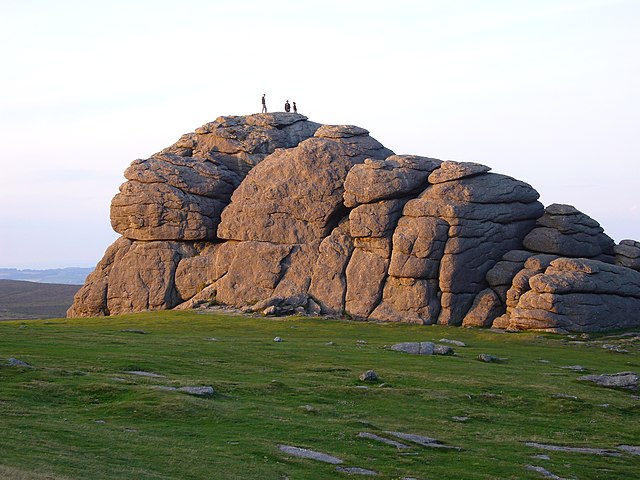
Spheroidal weathering is a form of chemical weathering that affects jointed bedrock and results in the formation of concentric or spherical layers of highly decayed rock within weathered bedrock that is known as saprolite. When saprolite is exposed by physical erosion, these concentric layers peel (spall) off as concentric shells much like the layers of a peeled onion. Within saprolite, spheroidal weathering often creates rounded boulders, known as corestones or woolsack, of relatively unweathered rock. Spheroidal weathering is also called onion skin weathering, concentric weathering, spherical weathering, or woolsack weathering.
Spheroidal or woolsack weathering in granite on Haytor, Dartmoor, England
Spheroidal weathering in granite, Estaca de Bares, A Coruña, Galicia, Spain
Woolsack weathering in sandstone at the Externsteine rocks, Teutoburg Forest, Germany
Corestones near Musina, South Africa that were created by spherodial weathering and exposed by the removal of surrounding saprolite by erosion.
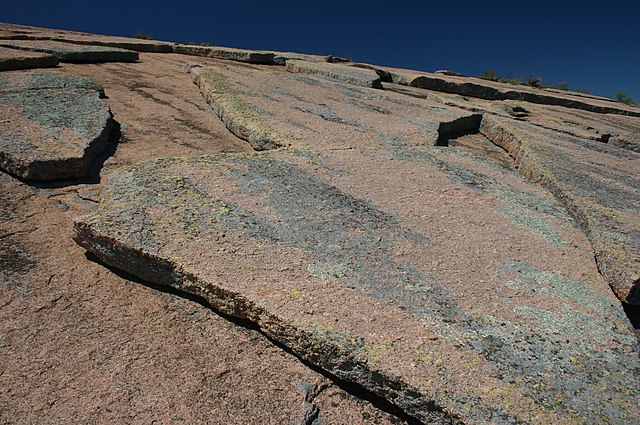
Exfoliating granite is a granite undergoing exfoliation, or onion skin weathering (desquamation). The external delaminated layers of granite are gradually produced by the cyclic variations of temperature at the surface of the rock in a process also called spalling. Frost and ice expansion in the joints during the winter accelerate the alteration process while the most unstable loosen external layers are removed by gravity assisted by runoff water.
Exfoliating slabs of granite, on Half Dome in Yosemite National Park, USA
Exfoliating granite, at Enchanted Rock State Natural Area, Texas