Spring (season)
Videos
Spring, also known as springtime, is one of the four temperate seasons, succeeding winter and preceding summer. There are various technical definitions of spring, but local usage of the term varies according to local climate, cultures and customs. When it is spring in the Northern Hemisphere, it is autumn in the Southern Hemisphere and vice versa. At the spring equinox, days and nights are approximately twelve hours long, with daytime length increasing and nighttime length decreasing as the season progresses until the Summer Solstice in June and December.
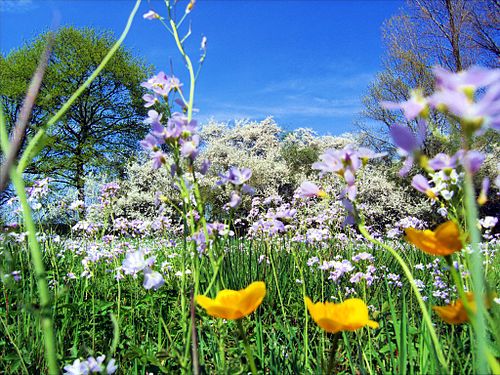
Blooming flowers and trees in spring

Hundreds of sour cherry blooming in Extremadura, Spain, during spring

Late April in the Alps. At high elevations (or latitudes), spring is often the snowiest period of the year.

A willow in Stockholm in April 2016
Imbolc
Videos
Imbolc or Imbolg, also called Saint Brigid's Day, is a Gaelic traditional festival. It marks the beginning of spring, and for Christians, it is the feast day of Saint Brigid, Ireland's patroness saint. Its traditional date is 1 February, about halfway between the winter solstice and the spring equinox. Historically, its traditions were widely observed throughout Ireland, Scotland and the Isle of Man. Imbolc is one of the four Gaelic seasonal festivals, along with: Beltane, Lughnasadh and Samhain.

Brigid's cross

Brigid's cross above a doorway in Downpatrick.

Painting of Saint Brigid with a bowl of fire, a spindle, and a cow in St. Patrick's Chapel, Glastonbury.

Snowdrops in the snow