Star of Bethlehem
Videos
The Star of Bethlehem, or Christmas Star, appears in the nativity story of the Gospel of Matthew chapter 2 where "wise men from the East" are inspired by the star to travel to Jerusalem. There, they m
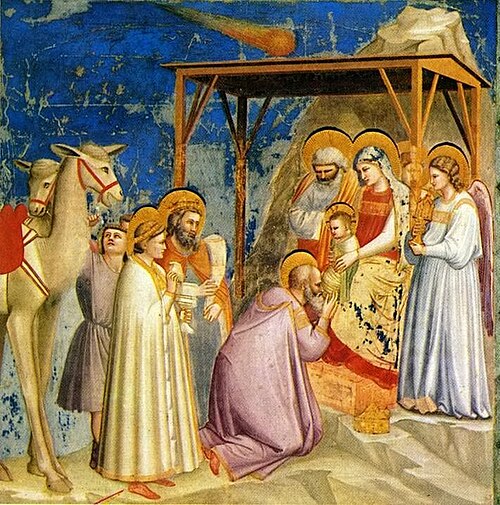
Adoration of the Magi by Florentine painter Giotto di Bondone (1267–1337). The Star of Bethlehem is shown as a comet above the child. Giotto witnessed an appearance of Halley's Comet in 1301.

Adoration of the Magi, Chartres Cathedral, by Jehan de Beauce, France, 16th century

Adoration of the Magi, by Jean Fouquet (15th century). The Star of Bethlehem can be seen in the top right. The soldiers and castle in the background may represent the Battle of Castillon (1453).

A zodiac from a 6th-century mosaic at a synagogue in Beit Alpha, Israel
Halley's Comet
Videos
Halley's Comet is the only known short-period comet that is consistently visible to the naked eye from Earth, appearing roughly every 74–79 years. It last appeared in the inner parts of the Solar Syst
Star of Bethlehem
…seen in the west at sunset it could not have led the magi south from Jerusalem to Bethlehem. Other writers highly suggest that the star was a comet. Halley's Comet was visible in 12 BC and another object, possibly a comet or nova, was seen by Korean and Chinese stargazers in about 5 BC. This object was observed…

Halley's Comet photographed by William Liller from Easter Island on 8 March 1986

"I must entreat you to procure for me of Mr Flamsteed what he has observed of the Comett of 1682 particularly in the month of September, for I am more and more confirmed that we have seen that Comett now three times, since yͤ Yeare 1531, he will not deny it you, though I know he will me." —Excerpt of Halley's letter to Newton about comet's orbits (September 28, 1695)

Jamaican polymath Francis Williams (portrait attributed to William Williams, c. 1760). The only contemporary illustration of an astronomer detecting the comet's return.

Orionid meteor originating from Halley's Comet streaking the sky below the Milky Way and to the right of Venus