Star system
Videos
A star system or stellar system is a small number of stars that orbit each other, bound by gravitational attraction. It may sometimes be used to refer to a single star. A large group of stars bound by

The Algol three-star system imaged in the near-infrared by the CHARA interferometer with 0.5 mas resolution in 2009. The shape of Algol C is an artifact.

Artist's impression of the orbits of HD 188753, a triple star system.
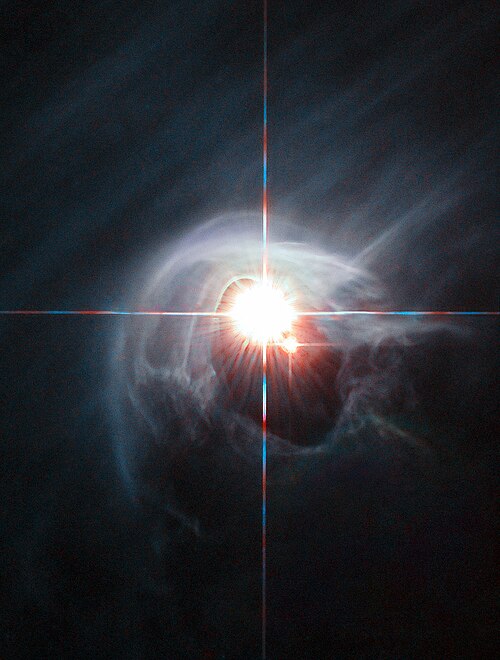
Star system named DI Cha. While only two stars are apparent, it is actually a quadruple system containing two sets of binary stars.

Sirius A (center), with its white dwarf companion, Sirius B (lower left) taken by the Hubble Space Telescope.
Fomalhaut
Videos
Fomalhaut is the brightest star in the southern constellation of Piscis Austrinus, the Southern Fish, and one of the brightest stars in the night sky. It has the Bayer designation Alpha Piscis Austrin
Fomalhaut is the brightest star in the constellation of Piscis Austrinus (center).


DSS image of Fomalhaut, field of view 2.7×2.9 degrees. Credit: NASA, ESA, and the Digitized Sky Survey 2. Acknowledgment: Davide De Martin (ESA/Hubble)

Dust ring around Fomalhaut from the Atacama Large Millimeter/submillimeter Array (ALMA)

This image shows the discovery features in the debris disk of Fomalhaut from the James Webb Space Telescope (JWST) as well as overlays of Hubble Space Telescope (HST) data and the Atacama Large Millimeter/submillimeter Array (ALMA).