Structural coloration
Videos
Structural coloration in animals, and a few plants, is the production of colour by microscopically structured surfaces fine enough to interfere with visible light instead of pigments, although some st

The brilliant iridescent colours of the peacock's tail feathers are created by structural coloration, as first noted by Isaac Newton and Robert Hooke.

In 1892, Frank Evers Beddard noted that Chrysospalax golden moles' thick fur was structurally coloured.
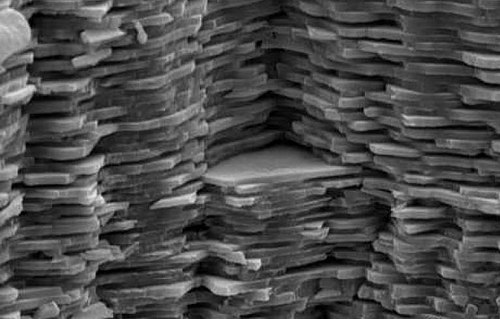
Electron micrograph of a fractured surface of nacre showing multiple thin layers

Butterfly wing at different magnifications reveals microstructured chitin acting as a diffraction grating
Iridescence
Videos
Iridescence is the phenomenon of certain surfaces that appear gradually to change colour as the angle of view or the angle of illumination changes. Iridescence is caused by wave interference of light
Structural coloration
…peacock tail feathers are pigmented brown, but their microscopic structure makes them also reflect blue, turquoise, and green light, and they are often iridescent. Structural coloration was first described by English scientists Robert Hooke and Isaac Newton, and its principle—wave interference—explained by Thomas…

Iridescence in soap bubbles

Fuel on top of water creates a thin film, which interferes with the light, producing different colours. The different bands represent different thicknesses in the film. This phenomenon is known as thin-film interference.

An iridescent biofilm on the surface of a fish tank diffracts the reflected light, displaying the entire spectrum of colours. Red is seen from longer angles of incidence than blue.

The pearlescent shell of a black-lip pearl oyster