Suibhne mac Duinnshléibhe
Videos
Suibhne mac Duinnshléibhe was a late 12th-century, and early 13th-century, lord in Argyll. He does not appear in contemporary records, although his name appears in the patronymic names of two of his s

Castle Sween, traditionally said, and later acknowledged to have been built by Suibhne

Interior of Castle Sween.
Dubhghall mac Suibhne
Videos
Dubhghall mac Suibhne was a Scottish landholder in Argyll, and a leading member of Clann Suibhne. He was a son of Suibhne mac Duinn Shléibhe, and appears to have held lordship of Knapdale from at leas
Suibhne mac Duinnshléibhe
…Donegal , and be reunited with their direct relatives, the Mac Duinnshléibhe physicians. Suibhne had two sons who appear in contemporary records. His son Dubhghall is recorded as granting, and witnessing, several charters. He was seated at Skipness Castle, in Kintyre. His other son, Maol Mhuire mac Suibhne married…

Now-ruinous Skipness Castle may have been constructed by Dubhghall. From this site, the castle's occupants would have had a clear view across the Kilbrannan Sound to Arran. The castle is first attested in 1261 by a charter which describes Dubhghall as its lord.

Now-ruinous Lochranza Castle may have been built by Dubhghall. The visible tower house is what remains of a late mediaeval redevelopment of a thirteenth-century hall house.

Ruinous Castle Sween, one of Scotland's oldest standing stone castles, seems to have been built by Dubhghall's father, eponym of both Clann Suibhne and the castle itself.
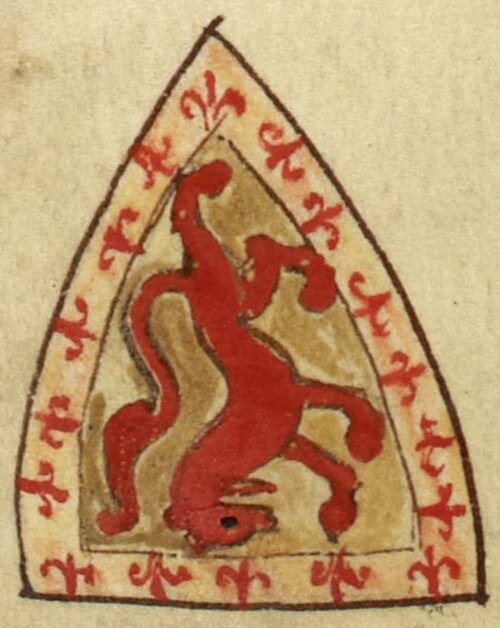
Coat of arms of Alexander II as it appears on folio 146v of British Library Royal 14 C VII (Historia Anglorum). The inverted shield represents the king's death in 1249.