Swiss Geodetic Commission
Videos
The Swiss Geodetic Commission is a commission of the Swiss Academy of Sciences, founded in 1861 within the framework of the Central European Arc Measurement, which later became the International Geode

Geneva old Observatory 1830

Gravimeter with variant of Repsold-Bessel pendulum.

Ibáñez apparatus calibrated on the metric Spanish standard and used at Aarberg, in canton of Bern, Switzerland in 1880.

Closeup of National Prototype Metre Bar No. 27, made in 1889 by the International Bureau of Weights and Measures (BIPM) in collaboration with Johnson Mattey and given to the United States, which served as the standard for American cartography from 1890 replacing the Committee Meter, an authentic copy of the Mètre des Archives produced in 1799 in Paris, which Ferdinand Rudolph Hassler had brought to the United States in 1805.
The arc measurement of Delambre and Méchain was a geodetic survey carried out by Jean-Baptiste Delambre and Pierre Méchain in 1792–1798 to measure an arc section of the Paris meridian between Dunkirk
Swiss Geodetic Commission
…The commission continues its work today, combining fundamental research with stimulating its practical application. Arc measurement of Delambre and Méchain Metre Convention…
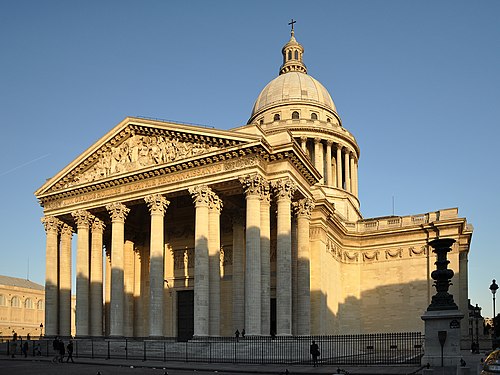
The Panthéon in Paris. At the time of Jean-Baptiste Joseph Delambre, it served as a warehouse for all the old weights and measures which had been sent by towns throughout France in anticipation of the standardisation of weights and measures by the establishment of the new decimal metric system.

The triangulation mesh of the Anglo-French Survey (1784–1790).

Repeating circle devised by Jean-Charles de Borda and constructed by Étienne Lenoir

The free-standing belfry in Dunkirk on the French English Channel coast – the northerly end of the meridian survey of 1792–9