Sydney Chapman was a British mathematician and geophysicist. His work on the kinetic theory of gases, solar-terrestrial physics, and the Earth's ozone layer has inspired a broad range of research over many decades.

Solar wind
Videos
The solar wind is a stream of charged particles released from the upper atmosphere of the Sun, called the corona. This plasma mostly consists of electrons, protons and alpha particles with kinetic energy between 0.5 and 10 keV. The composition of the solar wind plasma also includes a mixture of materials found in the solar plasma: trace amounts of heavy ions and atomic nuclei of elements such as Carbon, Nitrogen, Oxygen, Neon, Magnesium, Silicon, Sulfur, and Iron. There are also rarer traces of some other nuclei and isotopes such as Phosphorus, Titanium, Chromium, and 58Ni, 60Ni, and 62Ni. Superimposed with the solar-wind plasma is the interplanetary magnetic field. The solar wind varies in density, temperature and speed over time and over solar latitude and longitude. Its particles can escape the Sun's gravity because of their high energy resulting from the high temperature of the corona, which in turn is a result of the coronal magnetic field. The boundary separating the corona from the solar wind is called the Alfvén surface.

Ulysses' observations of solar wind speed as a function of helio latitude during solar minimum. Slow wind (≈400 km/s) is confined to the equatorial regions, while fast wind (≈750 km/s) is seen over the poles. Red/blue colors show outward/inward polarities of the heliospheric magnetic field.

Laboratory simulation of the magnetosphere's influence on the solar wind; these auroral-like Birkeland currents were created in a terrella, a magnetised anode globe in an evacuated chamber.

This is thought to show the solar wind from the star L.L. Orionis generating a bow shock (the bright arc)
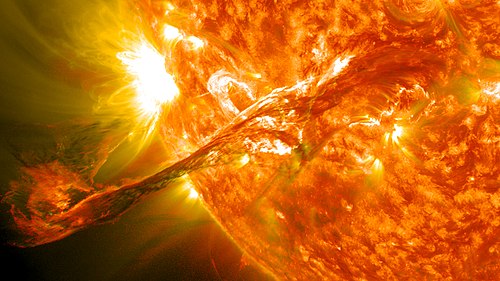
CME erupts from Earth's Sun