Synagogue architecture
Videos
Synagogue architecture often follows styles in vogue at the place and time of construction. There is no set blueprint for synagogues and the architectural shapes and interior designs of synagogues vary greatly. According to tradition, the Shekhinah or divine presence can be found wherever there is a minyan, a quorum, of ten. A synagogue always contains an Torah ark where the Torah scrolls are kept, called the aron qodesh by Ashkenazi Jews and the hekhal by Sephardic Jews.
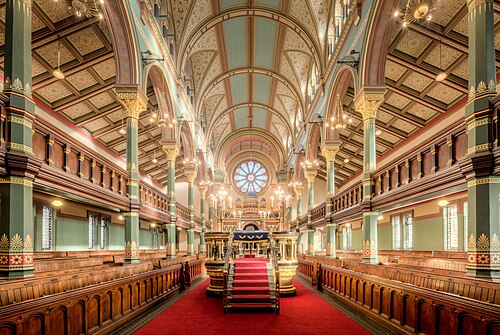
The late 19th century Princes Road Synagogue, Liverpool, United Kingdom

The 16th century Spanish Synagogue in Venice, Italy, a "clandestine" synagogue not giving any external sign of its function.

Oriental style—Belz Great Synagogue (2000), Jerusalem.

Lille Synagogue, France. An eclectic hybrid with Moorish, Romanesque, classical and Baroque elements, 1892.
New Synagogue (Mainz)
Videos
The New Synagogue of Mainz is in use since 2010 as a community center at the location of the former main synagogue on the Hindenburgstraße of Mainz Neustadt. Due to controversial discussions regarding the street name, the location in the Hindenburgstraße was renamed as Synagogenplatz.

View from the street

New Synagogue Mainz

New Synagogue, entrance

In the foreground remains of the former Main Synagogue from 1912