Týr is a god in Germanic mythology and member of the Æsir. In Norse mythology, which provides most of the surviving narratives about gods among the Germanic peoples, Týr sacrifices his right hand to t
Tyr and Fenrir (1911) by John Bauer
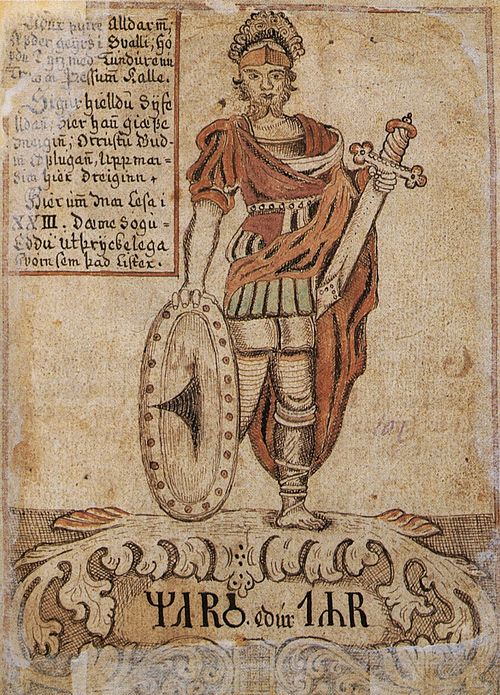
Týr equated with Mars in an 18th-century manuscript (ÍB 299 4to)
Týr and Thor observing Thor's lamed goat; illustration of Hymiskviða by Lorenz Frølich, 1895
Týr losing his hand so that the wolf Fenrir can be bound, in an 18th-century Icelandic manuscript
Æsir or ēse are gods in Germanic paganism. In Old Nordic religion and mythology, the precise meaning of the term Æsir is debated, as it can refer either to the gods in general or specifically to one o
Æsir gathered around the body of Baldr. Painting by Christoffer Wilhelm Eckersberg, 1817
The Eyrarland Statue, typically interpreted as depicting Thor. Thor's riding across the sky is likely reflected in the modern Swedish word for "thunderstorm" – Swedish: åska, deriving from an earlier form meaning "the driving of the áss".
Óðinn throws his spear in the Æsir-Vanir war, illustration by Lorenz Frølich (1895)
Snæfell in Iceland, where according to Barðar saga, Barðr Snæfellsáss became an áss who was worshipped in the region and protected those who lived there.