T-26
Videos
The T-26 tank was a Soviet light tank used during many conflicts of the Interwar period and in World War II. It was a development of the British Vickers 6-Ton tank and was one of the most successful t

T-26 mod. 1933 at the "Breaching of the Leningrad Blockade" museum near Kirovsk, Leningrad Oblast. This tank was raised from the river bottom at Nevsky Pyatachok in May 2003.

The prototype of the TMM-1 light infantry tank during tests in early 1932

Maintenance of the T-26 mod. 1931 (with riveted hull and turrets). This tank was produced in the first half of 1932—the exhaust silencer is mounted with two clamps and the cover over the air outlet window. The Moscow Military District. Mid-1934.

Interior of T-26 mod. 1933 turret. Ammunition stowage is on the left side. The side observation device is visible, as is the revolver firing port, which is closed with a plug. Parola Tank Museum in Finland.
Light tank
Videos
A light tank is a tank variant initially designed for rapid movements in and out of combat, and to outmaneuver heavier tanks. It is a smaller classification with thinner armor and a less powerful main

The M24 Chaffee, an American light tank used during the later part of World War II, and several subsequent conflicts

US Army operating Renault FT tanks
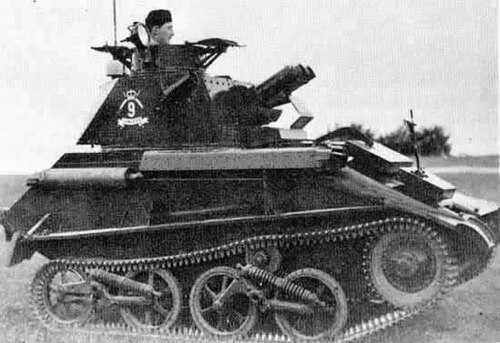
British light tank Mk V

Type 95 Ha-Go tanks in New Britain following the Japanese surrender