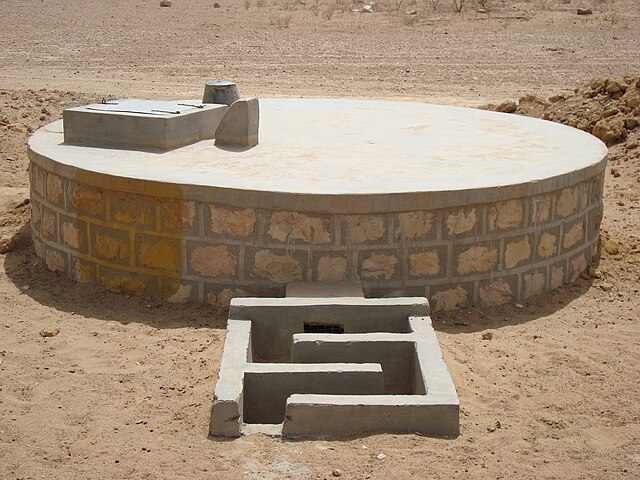
A taanka or paar, is a traditional rainwater harvesting technique, common to the Thar desert region of Rajasthan, India. It is meant to provide drinking water and water security for a family or a small group of families. A taanka is composed of a covered, underground, impermeable cistern on shallow ground for the collection of rainwater. The cistern is generally constructed out of stone or brick masonry, or concrete, with lime mortar or cement plaster. Rainwater or surface run-off from rooftops, courtyards, or artificially prepared catchments flow into the tank through filtered inlets in the wall of the pit.
A Taanka
A johad, also known as a pokhar or a percolation pond, is a community-owned traditional harvested rainwater storage wetland principally used for effectively harnessing water resources in the states of Haryana, Rajasthan, Punjab, and western Uttar Pradesh of North India, that collects and stores water throughout the year, to be used for the purpose of recharging the groundwater in the nearby water wells, washing, bathing and drinking by humans and cattle. Some johads also have bricked or stones masonry and cemented ghat.
Nadi (small johad) in Laporiya village of Rajasthan.
Johad at Rithal village of Rohtak district of Haryana
Johad at Rithal village of Rohtak district of Haryana
Rajendra Singh, founder of Tarun Bharat Sangh NGO explaining the use of johad to the students of TERI University in Alwar district of Rajasthan