Taijitu
Videos
In Chinese philosophy, a taijitu is a symbol or diagram representing taiji in both its monist and its dualist forms. A taijitu in application provides a deductive and inductive theoretical model. Such
Diagram of Continuation-Inversion (順逆之圖), based on the Taijitu, first published in 1611

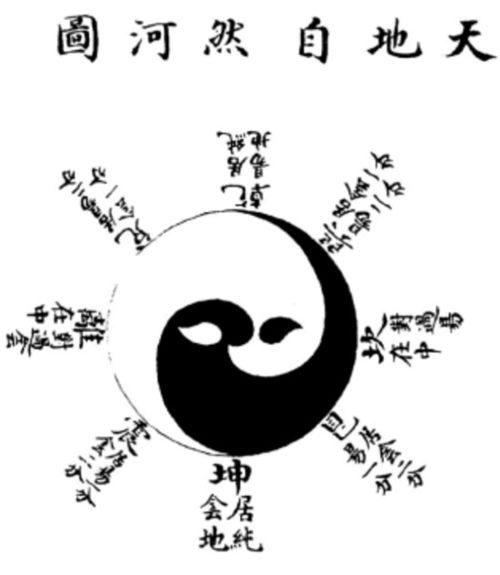
Diagram from Zhao Huiqian's Liushu benyi (1370s) as represented in the Siku Quanshu edition (1751)

Simplified form of Lai Zhide's "Taiji River Diagram" (1599)

"The Great Monad" from Edna Kenton's Book of Earths (1928), after the design shown by Hampden Coit DuBose (1887)
Taoism
Videos
Taoism or Daoism is a philosophical and religious tradition indigenous to China, emphasizing harmony with the Tao 道. With a range of meanings and interpretations in Chinese philosophy, translations of
Taijitu
…model. Such a diagram was first introduced by Neo-Confucian philosopher Zhou Dunyi of the Song Dynasty in his Taijitu shuo (太極圖說). The Fourth Daozang, a Taoist canon compiled in the 1440s CE during the Ming dynasty, has at least half a dozen variants of the taijitu. The two most similar are the Taiji Xiantiandao…

Purple Cloud Temple in the Wudang Mountains, part of the Sacred Mountains of Taoism

Laozi Riding an Ox by Zhang Lu (c. 1464–1538)
![Han dynasty Chinese talisman, part of the Wucheng Bamboo-slips [zh]](https://upload.wikimedia.org/wikipedia/commons/thumb/8/8d/Chinese_Fulu_talisman_han_dynasty_%E4%B9%8C%E7%A8%8B%E6%B1%89%E7%AE%80%E6%B5%99%E6%B1%9F%E5%87%BA%E5%9C%9F.jpg/500px-Chinese_Fulu_talisman_han_dynasty_%E4%B9%8C%E7%A8%8B%E6%B1%89%E7%AE%80%E6%B5%99%E6%B1%9F%E5%87%BA%E5%9C%9F.jpg)
Han dynasty Chinese talisman, part of the Wucheng Bamboo-slips [zh]

Zhang Daoling, the first Celestial Master