Tambourine
Videos
The tambourine is a musical instrument in the percussion family consisting of a frame, often of wood or plastic, with pairs of small metal jingles, called "zills". Classically the term tambourine deno

Pandeiro new 30 09 07

Ancient Greek red-figure pottery depicting a girl playing the tambourine. Bourgas Archaeology Museum

Woman holding a mirror and a tambourine facing a winged genie with a ribbon and a branch with leaves. Ancient Greek red-figure oinochoe, c. 320 BC, from Magna Graecia. (Notice the coloured decorative woven stripes hanging on the tambourine, which can still be seen today on the tamburello, the tambourine of Southern Italy.)

Maenad playing a tympanum. Detail from the Triumph of Dionysus, on a Roman mosaic from Tunisia (3rd century AD).
Frame drum
Videos
A frame drum is a drum that has a drumhead width greater than its shallow depth. It is one of the most ancient musical instruments. It has a single drumhead that is usually made of rawhide, but man-ma
Tambourine
…throughout the Arabic-speaking world. The instruments are widely known as shakers. A dayereh (or doyra, dojra, dajre, doira, daire) is a medium-sized frame drum with jingles used to accompany both popular and classical music in Iran (Persia), the Balkans, and many central Asian countries such as Afghanistan…
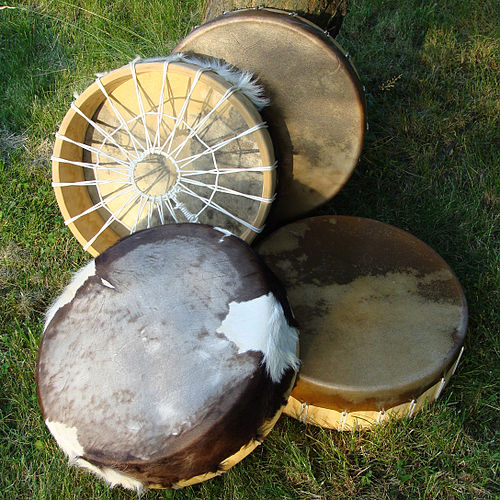
Different frame drums