Tang poetry
Videos
Tang poetry refers to poetry written in or around the time of or in the characteristic style of China's Tang dynasty, and/or follows a certain style, often considered as the Golden Age of Chinese poetry. The Complete Tang Poems includes over 48,900 poems written by over 2,200 authors. During the Tang dynasty, poetry continued to be an important part of social life at all levels of society. Scholars were required to master poetry for the civil service exams, but the art was theoretically available to everyone. This led to a large record of poetry and poets, a partial record of which survives today. The two most famous poets of the period were Li Bai and Du Fu. The Qing dynasty selection, Three Hundred Tang Poems, has made Tang poetry familiar to educated Chinese in modern times.

Eight Immortals of the Wine Cup, depicting few of the prominent poets of the Tang Dynasty, such as He Zhizhang, Li Jin, Li Shizhi, Li Bai, and Zhang Xu.

A Tang dynasty era copy of the preface to the Lantingji Xu poems composed at the Orchid Pavilion Gathering, originally attributed to Wang Xizhi (303–361 AD) of the Jin dynasty

A poem by Li Bai (701–762 AD), the only surviving example of Li Bai's calligraphy, housed in the Palace Museum in Beijing.
Li Bai
Videos
Li Bai, formerly pronounced Li Bo, courtesy name Taibai (太白), was a Chinese poet acclaimed as one of the greatest and most important poets of the Tang dynasty and in Chinese history as a whole. He and his friend Du Fu (712–770) were two of the most prominent figures in the flourishing of Chinese poetry under the Tang dynasty, which is often called the "Golden Age of Chinese Poetry". The expression "Three Wonders" denotes Li Bai's poetry, Pei Min's swordplay, and Zhang Xu's calligraphy.


Li Bai, as depicted in the Nanling Wushuang Pu by Jin Guliang, Ming dynasty

The China of Li Bai and Du Fu
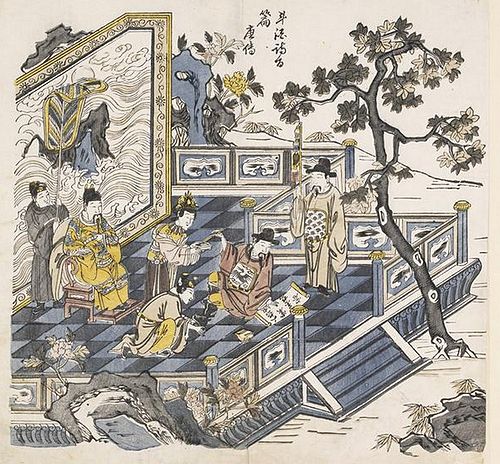
Emperor Minghuang, seated on a terrace, observes Li Bai write poetry while having his boots taken off (Qing dynasty illustration).