Tantō
Videos
A tantō is one of the traditionally made Japanese swords that were worn by the samurai class of feudal Japan. The tantō dates to the Heian period, when it was mainly used as a weapon but evolved in design over the years to become more ornate. Tantō were used in traditional martial arts. The term has seen a resurgence in the West since the 1980s as a point style of modern tactical knives, designed for piercing or stabbing.


Tantō Terasawa Sadamune, by Sadamune. Kamakura period. National Treasure. Tokyo National Museum.

Tantō made by Soshu Yukimitsu. Kamakura period. National Treasure (top). Mounting for a tantō made by Soshu Yukimitsu. Edo period (bottom).

Tantō by Hyūga Masamune, 24.8 cm (9.8 in), unsigned, formerly in the possession of Ishida Mitsunari, who gave it to his brother-in-law; the tantō was stolen during the Battle of Sekigahara by Mizuno Katsushige, governor of Hyūga Province in the Kamakura period.
Daishō
Videos
The daishō —"large and small"—is a Japanese term for a matched pair of traditionally made Japanese swords (nihonto) worn by the samurai class in feudal Japan.

Daishō style sword mounting, gold banding on red-lacquered ground. 16th century, Azuchi–Momoyama period. Important Cultural Property. Tokyo National Museum.

Daishō mountings with ice crack pattern design. Edo period, Designated as Important Mounting, The Japanese Sword Museum
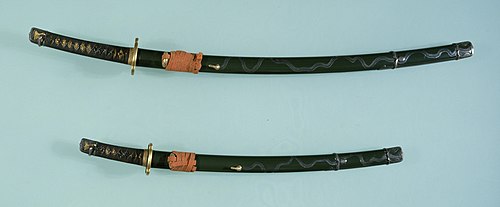
Daishō style handachi "half tachi" sword mounting, silver stream design on green lacquer ground. 16th–17th century, Azuchi Momoyama-Edo period. Tokyo National Museum.

Daishō for formal attire with black scabbard, hilt winding thread and white ray skin hilt, which were regulated by the Tokugawa Shogunate. Daishō owned by Uesugi clan. Late Edo period.