The Book of Thel
Videos
The Book of Thel is a poem by William Blake, dated 1789 and probably composed in the period 1788 to 1790. It is illustrated by his own plates, and compared to his later prophetic books is relatively s
William Blake: The Book of Thel, copy O, plate 1. Copy O, in the collection of the Library of Congress, is one of the two 1815-18 printings of Thel; the other is Copy N, in the collection of the Cincinnati Art Museum.


Plate 01 of the Book of Thel with Thel's Motto. This version of the image is from copy F currently held at the Library of Congress.
Tiriel
Videos
Tiriel is a narrative poem by William Blake, written c.1789. Considered the first of his prophetic books, it is also the first poem in which Blake used free septenaries, which he would go on to use in
The Book of Thel
…plates, and compared to his later prophetic books is relatively short and easier to understand. The metre is a fourteen-syllable line. It was preceded by Tiriel, which Blake left in manuscript. A few lines from Tiriel were incorporated into The Book of Thel. Most of the poem is in unrhymed verse. This book…

Tiriel supporting Myratana (Yale Center for British Art); the illustrated text is: "The aged man raisd up his right hand to the heavens/His left supported Myratana shrinking in the pangs of death" (1:19-20). Three of Tiriel's sons are opposite, including his eldest, Heuxos (with the crown). The pyramid, river and columns are not mentioned in the text, which instead describes a "beautiful palace" (1:1) and a "once delightful palace" (1:4).
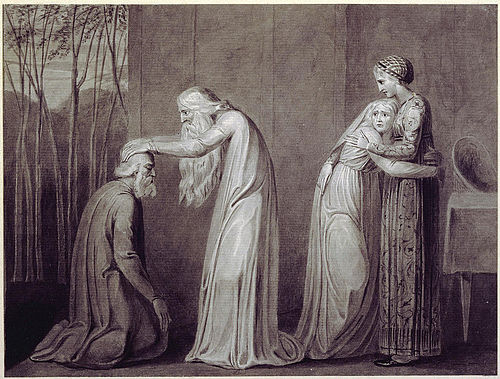
Har blessing Tiriel while Mnetha comforts Heva (British Museum); the illustrated text is: "Then Har arose and laid his hand on old Tiriel's head" (2:35).
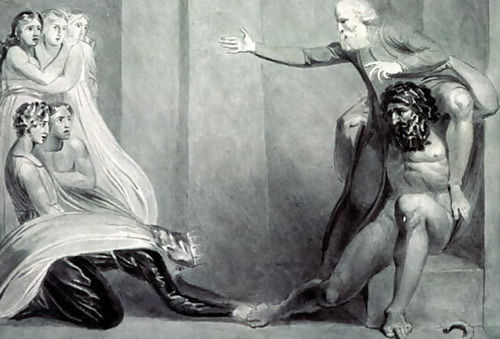
Tiriel borne back to the palace on the shoulders of his brother Ijim (Victoria and Albert Museum); the illustrated text is "All day he bore him & when evening drew her solemn curtain/Enterd the gates of Tiriels palace. & stood & calld aloud/…/Tiriel raisd his silver voice/Serpents not sons why do you stand fetch hither Tiriel/Fetch hither Myratana & delight yourselves with scoffs/For poor blind Tiriel is returnd & this much injurd head/Is ready for your bitter taunts. come forth sons of the curse" (4:40-41, 62–66).

Har and Heva sleeping while Mnetha looks on (British Museum); the illustrated text is: "And in the night like infants slept delighted with infant dreams" (2:9).