The Colours of Animals
Videos
The Colours of Animals is a zoology book written in 1890 by Sir Edward Bagnall Poulton. It was the first substantial textbook to argue the case for Darwinian selection applying to all aspects of anima
Cover of first edition


Title page of first edition of The Colours of Animals, 1890
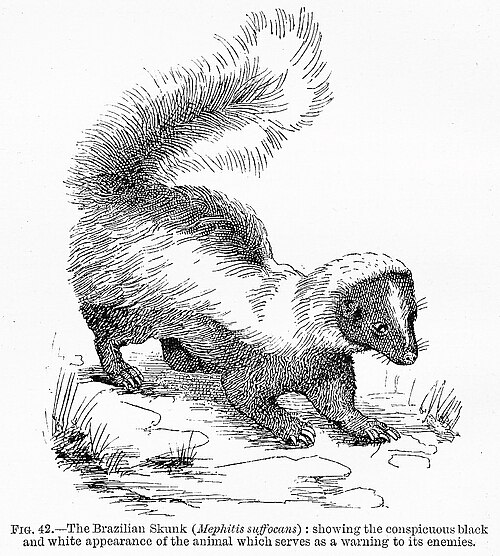
Warning coloration of the "Brazilian Skunk" in The Colours of Animals

Frontispiece: Mimicry in South African Butterflies, the only chromolithograph in the book
Adaptive Coloration in Animals is a 500-page textbook about camouflage, warning coloration and mimicry by the Cambridge zoologist Hugh Cott, first published during the Second World War in 1940; the bo
The Colours of Animals
…coloration" followed his views, citing Frank Evers Beddard's 1892 Animal Coloration as evidence. In his Introduction to Hugh Bamford Cott's 1940 book Adaptive Coloration in Animals, Julian Huxley praised Cott's work as "a worthy successor to Sir Edward Poulton's The Colours of Animals... The one was a pioneer study, the other is…

Cover of first edition

Cott's diagrammatic explanation of "the principle of maximum disruptive contrast, and showing the distractive effect upon the eye of patterns which contrast as violently as possible with the tone of their background"

Cott's accurate drawing of the potoo, disruptively coloured and perched to resemble a broken branch

Cott's art in the service of zoology: the four-eye butterfly fish, Chaetodon capistratus, showing two adaptations at once: concealment of the eye, and distraction with an eyespot. Fig. 76 from Adaptive Coloration in Animals