The Feast in the House of Levi or Christ in the House of Levi is a 1573 oil painting by Italian painter Paolo Veronese and one of the largest canvases of the 16th century, measuring 555 cm × 1,309 cm.
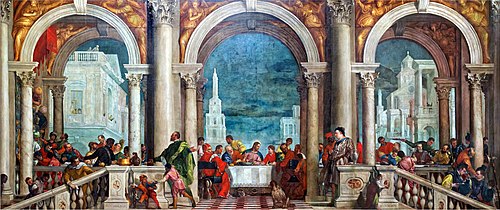
The Feast in the House of Levi by Paolo Veronese

Saints Peter and John flank Christ, with Judas the uneasy figure in red

Detail of child

Detail of Jester with a parrot on his arm and an Apostle picking his teeth with a fork
Paolo Veronese
Videos
Paolo Caliari, known as Paolo Veronese, was an Italian Renaissance painter based in Venice, known for extremely large history paintings of religion and mythology, such as The Wedding at Cana and The F
The Feast in the House of Levi
…The Feast in the House of Levi or Christ in the House of Levi is a 1573 oil painting by Italian painter Paolo Veronese and one of the largest canvases of the 16th century, measuring 555 cm × 1,309 cm (18.21 ft × 42.95 ft). It is now in the Gallerie dell'Accademia, in…

Self-portrait, 1558–1563, Hermitage Museum

The Family of Darius before Alexander (1565–1570). Oil on canvas, 236.2cm × 475.9 cm, National Gallery, London.

Deposition of Christ, c. 1547, Castelvecchio Museum

The Conversion of Mary Magdalene, c. 1548, National Gallery