The Wedding at Cana
Videos
The Wedding Feast at Cana, by Paolo Veronese, is a representational painting that depicts the biblical story of the Wedding at Cana, at which Jesus miraculously converts water into red wine. Executed in the Mannerist style (1520–1600) of the late Renaissance, the large-format oil painting comprehends the stylistic ideal of compositional harmony, as practised by the artists Leonardo, Raphael, and Michelangelo.
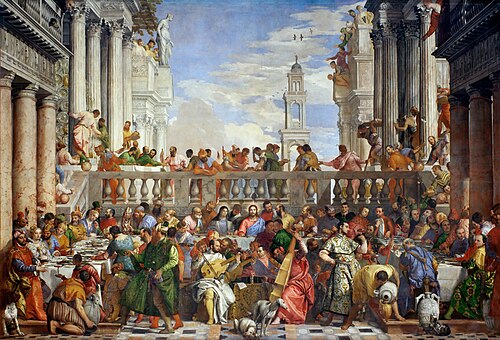

In 1562, the Benedictine monks commissioned Paolo Veronese to realise The Wedding Feast at Cana as a monumental painting (6.77m × 9.94m) to occupy the back wall of the monastery's refectory, at the San Giorgio Monastery, Venice.
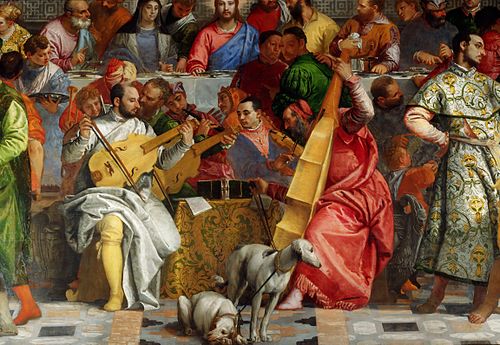
The musicians providing ambience for The Wedding Feast at Cana are personified by Veronese (viola da braccio), and the principal painters of the Venetian school: Jacopo Bassano (cornetto), Tintoretto (viola da braccio) and Titian (violone); standing beside Titian is the poet Pietro Aretino. (detail, lower centre-plane)

In The Wedding Feast at Cana, Veronese shows the sated guests at the nuptial banquet-table awaiting the dessert-course wine service. The guests awaiting the new, red wine include Suleiman the Magnificent, an elegant woman discreetly cleaning her teeth with a toothpick, and a woman urging her husband to ask the bride about the new red wine they have been served. (detail, left lower-quarter)
Wedding at Cana
Videos
The wedding at Cana is the name of the story in the Gospel of John at which the first miracle attributed to Jesus takes place.

Marriage at Cana, c. 1500, Gerard David, Musée du Louvre, Paris

The calling of Apostle John at the Marriage at Cana, c. 1530, Jan Cornelisz Vermeyen

Marriage at Cana, 1561, Jacopo Tintoretto