Third Battle of Panipat
Videos
The Third Battle of Panipat took place on 14 January 1761 between the Maratha Empire and the invading army of the Durrani Empire. The battle took place in and around the city of Panipat, approximately
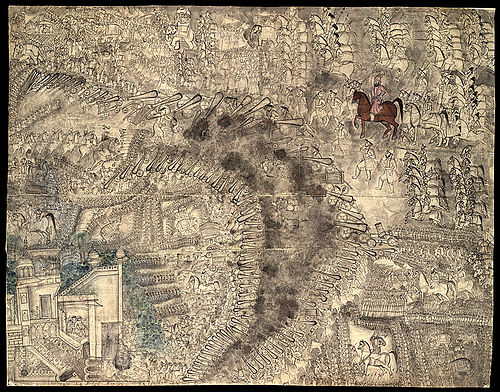
Faizabad-style painting of the Third Battle of Panipat; the centre of the image is dominated by the twin arcs of the lines of guns firing at each other with smoke and destruction in between c. 1770

Sadashivrao Bhau

Portrait of Ahmad Shah Durrani

Balaji Rao's troops under the command of his cousin Sadashivrao Bhau fighting at Panipat
Ibrahim Khan Gardi
Videos
Ibrahim Khan Gardi was a South Indian Muslim general of the Maratha Empire. An expert in artillery, he initially served the Nizam of Hyderabad, before working for the Peshwa of the Maratha Empire. As
Third Battle of Panipat
…supplies—by those same troops. Bhau, with the Peshwa's son and the royal guard (Huzurat), was in the centre. The left wing consisted of the Gardis under Ibrahim Khan. Holkar and Sindhia were on the extreme right. The Maratha line was formed up some 12 km across, with the artillery in front, protected by infantry…

Ibrahim Khan Gardi with Sadashivrao Bhau