Tilting train
Videos
A tilting train is a train that has a mechanism enabling increased speed on regular rail tracks. As a train rounds a curve at speed, it experiences centripetal force, pushing on objects inside it. Thi
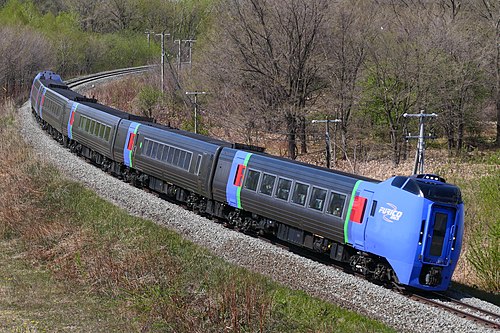
A Japanese KiHa 283 series tilting DMU, which can tilt up to 8° (6° in normal operation)

A ČD Class 680 Pendolino train in July 2006

A Swiss SBB RABDe 500 on the Hauenstein railway line in May 2007

British Rail Class 370 (APT) passing Carlisle in 1984
Pendolino
Videos
Pendolino is an Italian family of high-speed tilting trains used in Italy, Spain, Germany, Poland, Portugal, Slovenia, Finland, the Czech Republic, Slovakia, the UK, the US, Switzerland, China, and Gr
Tilting train
…381 series, that has been in service since 1973. In parallel, Fiat Ferroviaria produced the experimental Y 0160 in 1970, that would evolve into the Pendolino family, in 1976, and operated in 11 countries. All of these had problems with short curves like those in switchyards, where they tended to sway about…

An ETR 600 high-speed train, operated by Trenitalia in 2023

The ETR 450 was the first production Pendolino train, in service from 1988 to 2015.

ETR 485 at Roma Termini railway station

An ETR 460 of Trenitalia at Sapri