Timeline of Sussex history
This is a timeline of Sussex history. To read about the background to these events, see History of Sussex. See also the list of monarchs of Sussex.
Roman masonry in the walls of Anderitum
Tombstone of Æthelwulf of Wessex, buried in 858 at Steyning
Bodiam Castle was constructed in 1385
Steel engraving of scene from Battle of Beachy Head
The Kingdom of the South Saxons, today referred to as the Kingdom of Sussex, was one of the seven traditional kingdoms of the Heptarchy of Anglo-Saxon England. On the south coast of the island of Great Britain, it was originally a sixth-century Saxon colony and later an independent kingdom. The kingdom remains one of the least known of the Anglo-Saxon polities, with no surviving king-list, several local rulers and less centralisation than other Anglo-Saxon kingdoms. The South Saxons were ruled by the kings of Sussex until the country was annexed by Wessex, probably in 827, in the aftermath of the Battle of Ellendun. In 860 Sussex was ruled by the kings of Wessex, and by 927 all remaining Anglo-Saxon kingdoms were ruled by them as part of the new kingdom of England.
A coin from the Patching Hoard was a gold solidus struck in the name of Severus III
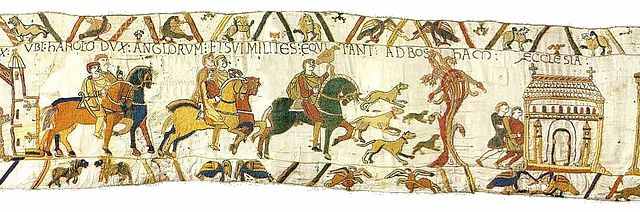
Harold Godwinson, the future king of England, shown on the Bayeux Tapestry riding with his knights to Bosham from where he set sail in 1064.
Remains of the burh wall at Burpham
Droveways such as this one near Chanctonbury Ring were used throughout the Saxon period to transport pigs and cattle between coastal areas and summer pasture in the Weald