Tirthankara
Videos
In Jainism, a Tirthankara is a saviour and supreme preacher of the dharma. The word tirthankara signifies the founder of a tirtha, a fordable passage across saṃsāra, the sea of interminable birth and

Jain miniature painting of 24 Jain Tirthankaras, Jaipur, c. 1850
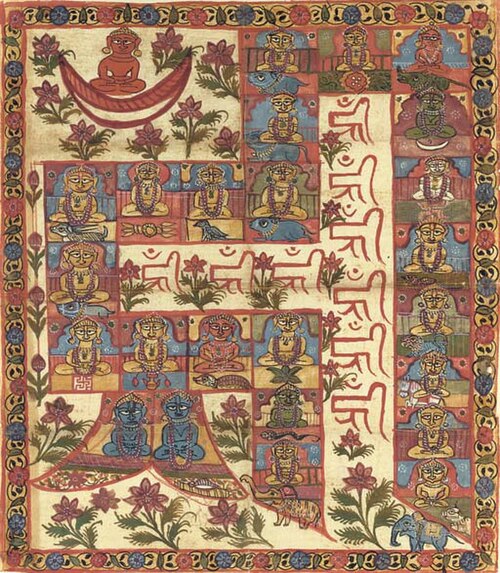
The 24 Tirthankaras forming the tantric meditative syllable Hrim, painting on cloth, Gujarat, c. 1800

Tirthankara images at Siddhachal Caves inside Gwalior Fort.

Auspicious 14 dreams seen by a tirthankara's mother during pregnancy as an ornamentation on cover of 19th-century manuscript
Rishabhanatha
Videos
Rishabhanatha, also Rishabhadeva, Rishabha or Ikshvaku, is the first tirthankara of Jainism. He was the first of twenty-four teachers in the present half-cycle of time in Jain cosmology and called a "
Tirthankara
…this part of the universe. There have been infinitely many tirthankaras in the past. The first tirthankara in the present cycle (Hunda Avsarpinī) was Rishabhanatha, who is credited with formulating and organising humans to live in a society harmoniously. The 24th and last tirthankara of the present half-cycle was…

Birth of the Tirthankara Rishabha, folio from the Devasano Pado Kalpasutra, Kalpasutra and Kalakacharya Katha. Gujarat, c. 1500. Bharat Kala Bhavan

An idol of Rishabha with mother Marudevi at Palitana

Ruins of ancient Jain settlement from 2nd century BCE in Kankali Tila, Mathura depicting the scene of Nilanjana's Dance from life of Rishabhdeva.

Statuary representing meditation by Rishabhanatha in Kayotsarga posture. (Photo:Ajmer Jain temple)