Tithonus poem
Videos
Photos
The Tithonus poem, also known as the old age poem or the New Sappho, is a poem by the archaic Greek poet Sappho. It is part of fragment 58 in Eva-Maria Voigt's edition of Sappho. The poem is from Book IV of the Alexandrian edition of Sappho's poetry. It was first published in 1922, after a fragment of papyrus on which it was partially preserved was discovered at Oxyrhynchus in Egypt; further papyrus fragments published in 2004 almost completed the poem, drawing international media attention. One of very few substantially complete works by Sappho, it deals with the effects of ageing. There is scholarly debate about where the poem ends, as four lines previously thought to have been part of the poem are not found on the 2004 papyrus.

Fragments of the Cologne papyri, dating to the third century BC, preserve twelve lines of the Tithonus poem. Published in 2004, the finds drew international media attention.

Tithonus, detail of Aurora e Titone c. 1635, Giovanni da San Giovanni
Sappho
Videos
Photos
Sappho was an Archaic Greek poet from Eresos or Mytilene on the island of Lesbos. Sappho is known for her lyric poetry, written to be sung while accompanied by music. In ancient times, Sappho was widely regarded as one of the greatest lyric poets and was given names such as the "Tenth Muse" and "The Poetess". Most of Sappho's poetry is now lost, and what is extant has mostly survived in fragmentary form; only the Ode to Aphrodite is certainly complete. As well as lyric poetry, ancient commentators claimed that Sappho wrote elegiac and iambic poetry. Three epigrams formerly attributed to Sappho are extant, but these are actually Hellenistic imitations of Sappho's style.
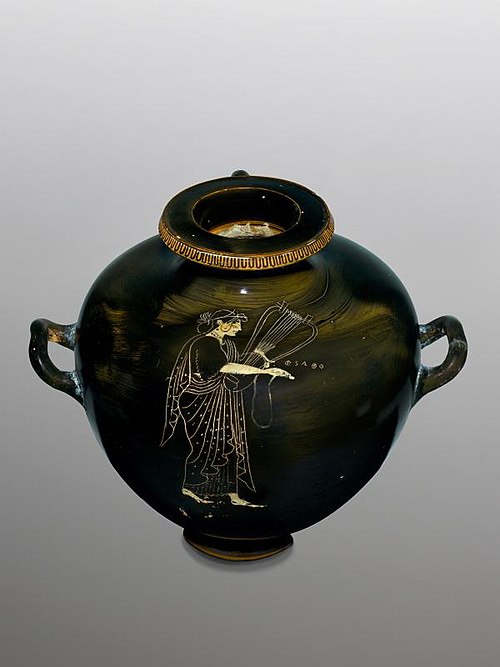
Kalpis painting of Sappho by the Sappho Painter (c. 510 BC), currently held in the National Museum, Warsaw

Head of a woman from the Glyptothek in Munich, possibly a copy of Silanion's fourth-century BC imaginative portrait of Sappho

Sappho, by Enrique Simonet.

Sappho (1877) by Charles Mengin (1853–1933). One tradition claims that Sappho committed suicide by jumping off the Leucadian cliff.