The Tomb of Yu Hong (Chinese: 虞弘墓; pinyin: Yú Hóng Mù; Wade–Giles: Yü2-Hung2-Mu4) is the grave of Yu Hong and his wife, dating back to 592 AD (Sui dynasty). The tomb was discovered by some locals in 1999 in Wangguo village in Jinyuan district of the city of Taiyuan, it was subsequently excavated officially in July of the same year. This tomb is so far the only archaeological find in the Central Plains region that reflects Central Asian (Western Regions) culture.
The rear of the marble sarcophagus of Yu Hong, in Shanxi Museum. The sarcophagus was originally covered with a hip-gable roof.
Epitaph of Yu Hong
Rubbing of Yu Hong's epitaph cover, carved with nine characters in seal script.
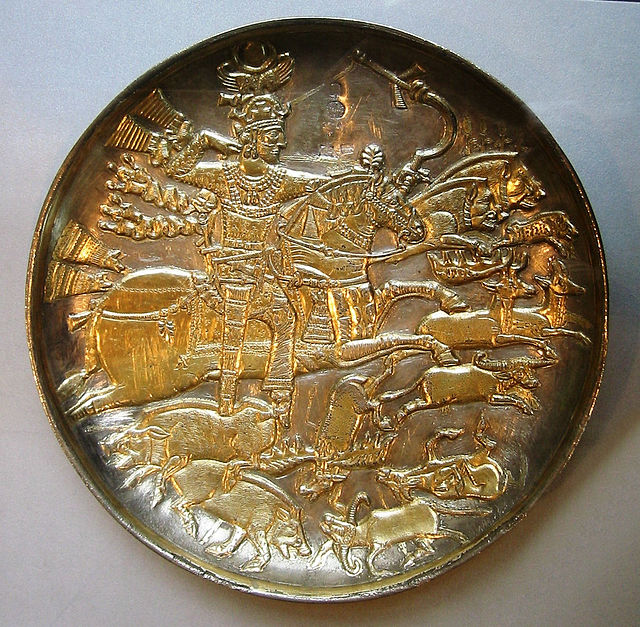
Hunting scene on a gilded silver plate showing Sasanian emperor Khosrow I, which shares similarities with the figures carved on Yu Hong's sarcophagus: the sun disc and crescent moon symbol, streamers flying behind headdress, position of riding figures, et cetera.
The Sui dynasty was a short-lived Chinese imperial dynasty that ruled from 581 to 618. The re-unification of China proper under the Sui brought the Northern and Southern dynasties era to a close, ending a prolonged period of political division since the War of the Eight Princes. The Sui endeavoured to rebuild the country, re-establishing and reforming many imperial institutions; in so doing, the Sui laid much of the foundation for the subsequent Tang dynasty, who after toppling the Sui would ultimately preside over a new golden age in Chinese history.
Tomb of Yu Hong, a Sogdian merchant buried in Taiyuan in 592. Shanxi Museum.
Tomb of An Bei panel showing a Sui dynasty banquet with Sogdian whirl dance and music, 589
Chinese swords of the Sui dynasty dated c. 600, found near Luoyang. The P-shaped furniture of the bottom sword's scabbard is similar to and may have been derived from sword scabbards of the Sarmatians and Sassanians.
Strolling About in Spring, by Sui-era artist Zhan Ziqian