Tornado outbreak sequence of May 2004
The tornado outbreak sequence of May 2004 was a series of tornado outbreaks that affected much of southern Ontario, the Central and Southern United States from east of the Rockies to the Mid-Atlantic States from May 21 to May 31, 2004. Particularly hard hit were the central Plains from Missouri to Iowa and the Ohio Valley. The Central Plains were hit by two significant outbreaks on May 22 and May 24, the first outbreak of which produced a very large and violent tornado in Hallam, Nebraska. The Ohio Valley was affected by one of the largest tornado outbreaks ever during the Memorial Day weekend on May 29–30.
Radar image of the supercell that spawned the Hallam, Nebraska, tornado.
Tornado damage in Hallam
More damage in Hallam
Dissipating tornado near Secor, Illinois on 30 May 2004
A tornado is a violently rotating column of air that is in contact with both the surface of the Earth and a cumulonimbus cloud or, in rare cases, the base of a cumulus cloud. It is often referred to as a twister, whirlwind or cyclone, although the word cyclone is used in meteorology to name a weather system with a low-pressure area in the center around which, from an observer looking down toward the surface of the Earth, winds blow counterclockwise in the Northern Hemisphere and clockwise in the Southern. Tornadoes come in many shapes and sizes, and they are often visible in the form of a condensation funnel originating from the base of a cumulonimbus cloud, with a cloud of rotating debris and dust beneath it. Most tornadoes have wind speeds less than 180 kilometers per hour, are about 80 meters across, and travel several kilometers before dissipating. The most extreme tornadoes can attain wind speeds of more than 480 kilometers per hour (300 mph), are more than 3 kilometers (2 mi) in diameter, and stay on the ground for more than 100 km (62 mi).

A tornado approaching Elie, Manitoba, Canada in June 2007.
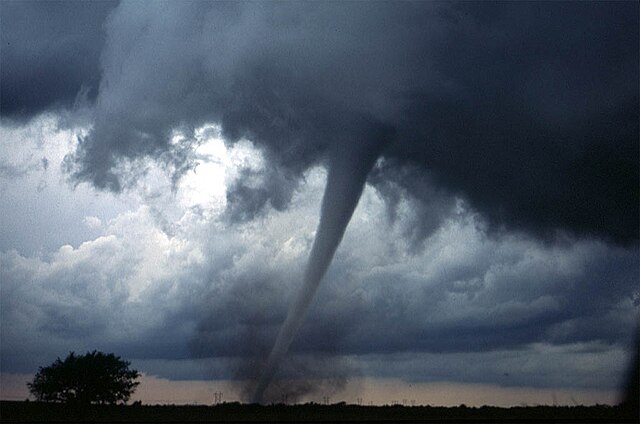
A tornado near Anadarko, Oklahoma, 1999. The funnel is the thin tube reaching from the cloud to the ground. The lower part of this tornado is surrounded by a translucent dust cloud, kicked up by the tornado's strong winds at the surface. The wind of the tornado has a much wider radius than the funnel itself.
This tornado has no funnel cloud; however, the rotating dust cloud indicates that strong winds are occurring at the surface, and thus it is a true tornado.
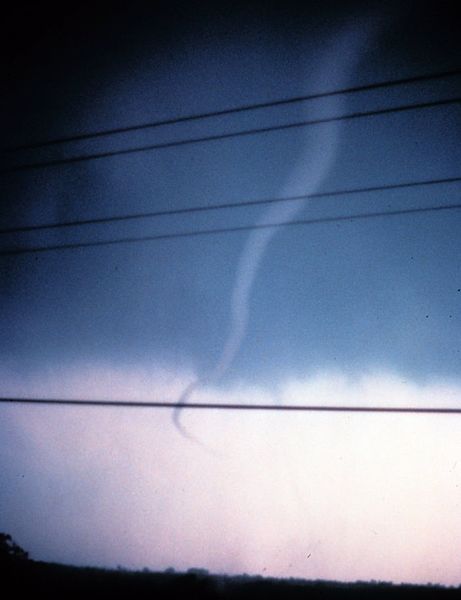
A rope tornado in its dissipating stage, found near Tecumseh, Oklahoma.