The Trans Canada Trail, officially named The Great Trail between September 2016 and June 2021, is a cross-Canada system of greenways, waterways, and roadways that stretches from the Atlantic to the Pacific to the Arctic oceans. The trail extends over 24,000 km (15,000 mi); it is now the longest recreational, multi-use trail network in the world. The idea for the trail began in 1992, shortly after the Canada 125 celebrations. Since then it has been supported by donations from individuals, corporations, foundations, and all levels of government.
Trans Canada Trail
Trail marker
Section of the Trans Canada Trail that is confluent with a road and has no dedicated pedestrian path, near Wakefield, Quebec.
The former eastern terminus of the Newfoundland T'Railway at the Railway Coastal Museum in St. John's, NL
A greenway is usually a shared-use path along a strip of undeveloped land, in an urban or rural area, set aside for recreational use or environmental protection. Greenways are frequently created out of disused railways, canal towpaths, utility company rights of way, or derelict industrial land. Greenways can also be linear parks, and can serve as wildlife corridors. The path's surface may be paved and often serves multiple users: walkers, runners, bicyclists, skaters and hikers. A characteristic of greenways, as defined by the European Greenways Association, is "ease of passage": that is that they have "either low or zero gradient", so that they can be used by all "types of users, including mobility impaired people".
Golf course in the Concordia neighborhood, one of many age-restricted communities with greenways in Monroe Township, Middlesex County, New Jersey, U.S.
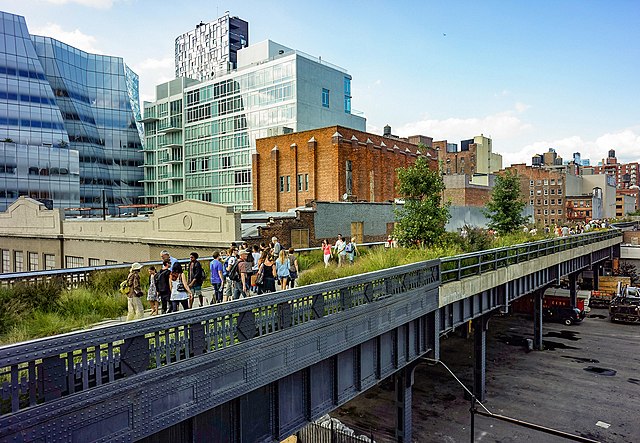
The High line, a rail-to-trail elevated linear park, is an urban greenway in Manhattan.
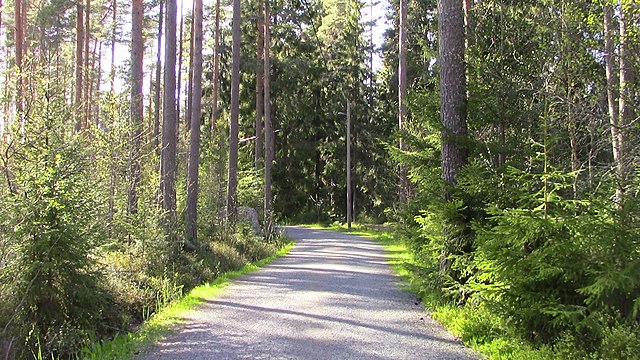
Jogging path in Pori, Finland
Railway Platforms on Parkland Walk in North London