Transistor
Videos
A transistor is a semiconductor device used to amplify or switch electrical signals and power. It is one of the basic building blocks of modern electronics. It is composed of semiconductor material, u

Transbauformen

Julius Edgar Lilienfeld proposed the concept of a field-effect transistor in 1925.

John Bardeen, William Shockley, and Walter Brattain at Bell Labs in 1948; Bardeen and Brattain invented the point-contact transistor in 1947 and Shockley invented the bipolar junction transistor in 1948.
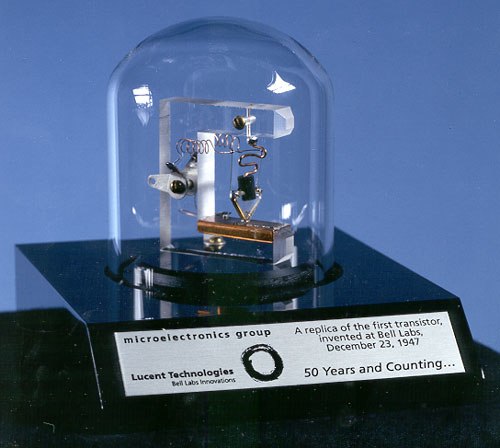
A replica of the first working transistor, a point-contact transistor invented in 1947
John Bardeen
Videos
John Bardeen was an American physicist. He is the only person to be awarded the Nobel Prize in Physics twice: first in 1956 with William Shockley and Walter Brattain for their invention of the transis
Transistor
…it was not possible to construct a working device at that time. The first working device was a point-contact transistor invented in 1947 by physicists John Bardeen, Walter Brattain, and William Shockley at Bell Labs who shared the 1956 Nobel Prize in Physics for their achievement. The most widely used type of…

Bardeen in 1956

A commemorative plaque at the University of Illinois Urbana-Champaign remembering John Bardeen and the theory of superconductivity