Trench railway
Videos
A trench railway was a type of railway that represented military adaptation of early 20th-century railway technology to the problem of keeping soldiers supplied during the static trench warfare phase

Transfer of ammunition from standard-gauge railway to trench railway during the Battle of Passchendaele.
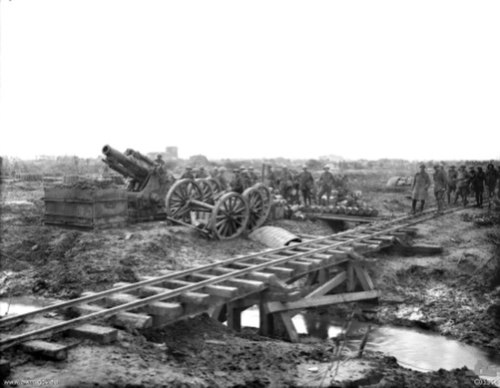
BL 9.2 inch Howitzer with shells lined up on the ground recently delivered from the trench railway in the foreground.

Australian 17th Light Railway Operating Company ballast train near Ypres pulled by Cooke 2-6-2 tank locomotive # 1217.

5th Australian Field Ambulance Company soldiers evacuating wounded from the front near Ypres in trench railway hand cars.
Two foot and 600 mm gauge railways are narrow-gauge railways with track gauges of 2 ft and 600 mm, respectively. Railways with similar, less common track gauges, such as 1 ft 11+3⁄4 in and 1 ft 11+1⁄2
Trench railway
…and other industrial uses. The French military became interested in light railways decades before the outbreak of World War 1, standardizing around the 600 mm (1 ft 11+5⁄8 in) Decauville system of narrow gauge rail for military equipment. In Germany a similar system of light and narrow-gauge rail called…

The Chemins de fer du Calvados' Caen station in France

A steam outline Schöma diesel locomotive on the Pelion railway in Greece

The Groudle Glen Railway Sea Lion locomotive c. 1910 on the Isle of Man