Triangulum
Videos
Triangulum is a small constellation in the northern sky. Its name is Latin for "triangle", derived from its three brightest stars, which form a long and narrow triangle. Known to the ancient Babylonia

The constellation Triangulum as it can be seen by the naked eye.

The peculiar asymmetry of NGC 949.

IC 1727 and UGC 1249.

The constellation Triangulum showing the IAU boundaries, the constellation stick figure, and labels for its brightest stars. Astrophotograph by Eckhard Slawik, from NOIRLab's 88 Constellations project.
Triangulum Galaxy
Videos
The Triangulum Galaxy is a spiral galaxy 2.878 million light-years from Earth in the constellation Triangulum. It is catalogued as Messier 33 or NGC 598. With the D25 isophotal diameter of 18.74 kilop
Triangulum
…are three star systems with known planets located in Triangulum. The constellation contains several galaxies, the brightest and nearest of which is the Triangulum Galaxy or Messier 33—a member of the Local Group. The first quasar ever observed, 3C 48, also lies within the boundaries of Triangulum. In the Babylonian star…

Galaxy Messier 33 in Triangulum (the Triangulum Galaxy)
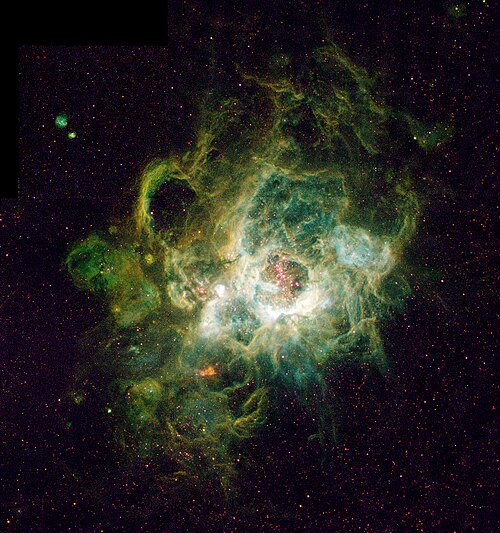
NGC 604 in the Triangulum Galaxy

Composite of about 54 different pointings with Hubble's Advanced Camera for Surveys
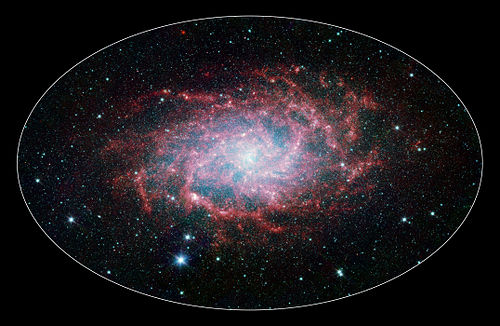
Infrared image of M33 taken with the Spitzer Space Telescope