The Triumphs of Caesar are a series of nine large paintings created by the Italian Renaissance artist Andrea Mantegna between 1484 and 1492 for the Gonzaga Ducal Palace, Mantua. They depict a triumpha

Picture Bearers (first canvas)

The Vase Bearers (fourth canvas)

One of a set of coloured chiaroscuro woodcuts with added gouache, among the finest in the technique, by Andrea Andreani, 1598/99

Rubens, c 1630: A Roman Triumph, National Gallery, London
Julius Caesar
Videos
Gaius Julius Caesar was a Roman general, statesman, and author who was the dictator of the Roman Republic almost continuously from 49 BC until his assassination in 44 BC. A member of the First Triumvi
Triumphs of Caesar (Mantegna)
…artist Andrea Mantegna between 1484 and 1492 for the Gonzaga Ducal Palace, Mantua. They depict a triumphal military parade celebrating the victory of Julius Caesar in the Gallic Wars. Acknowledged from the time of Mantegna as his greatest masterpiece, they remain the most complete pictorial representation of a…

The Tusculum portrait, the only extant contemporary sculpture of Caesar

Sulla, depicted on the obverse of a denarius minted by Quintus Pompeius Rufus in 54 BC. Sulla took the city in 82 BC, purged his political enemies, and instituted new constitutional reforms.
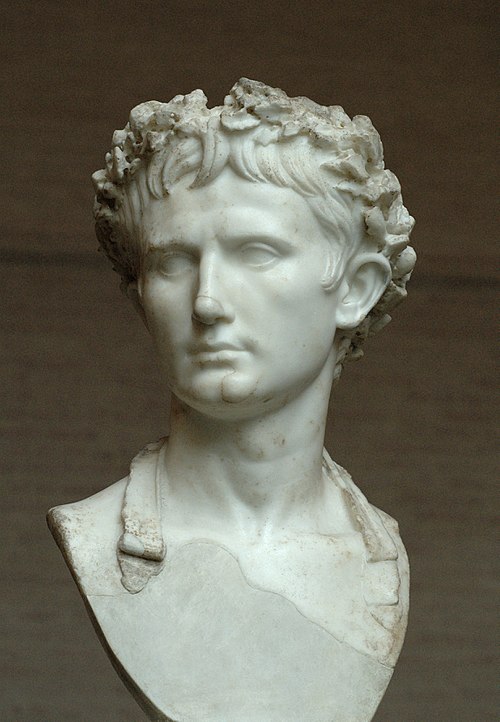
Imperial period bust of Augustus (known as the Augustus Bevilacqua) wearing the civic crown (Latin: corona civica). Caesar won the civic crown for his bravery at the Siege of Mytilene in 81 BC.

Denarius of C. Cossutius Maridianus, 44 BC, with the head of Julius Caesar as pontifex maximus on the obverse. The legend on the reverse mentions the A. A. A. F. F.