Trust (business)
Videos
A trust or corporate trust is a large grouping of business interests with significant market power, which may be embodied as a corporation or as a group of corporations that cooperate with one another

The Rockefeller-Morgan Family Tree (1904), which depicts how the largest trusts at the turn of the 20th century were in turn connected to each other
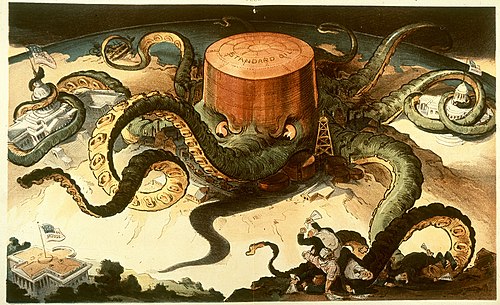
Octopus representing Standard Oil with arms wrapped around U.S. Congress and steel, copper, and shipping industries, and reaching for the White House
Competition law
Videos
Competition law, also known as antitrust law, is the field of law that promotes and maintains market competition by regulating anti-competitive conduct by companies.
Trust (business)
…Commission for similar purposes, federalizing the movement against anti-competitive business practices. In 1898, President William McKinley launched the trust-busting era (one aspect of the Progressive Era) when he appointed the U.S. Industrial Commission. Theodore Roosevelt seized upon the commission's report and…

Senatorial Round House by Thomas Nast, 1886