Trust (business)
Videos
A trust or corporate trust is a large grouping of business interests with significant market power, which may be embodied as a corporation or as a group of corporations that cooperate with one another

The Rockefeller-Morgan Family Tree (1904), which depicts how the largest trusts at the turn of the 20th century were in turn connected to each other
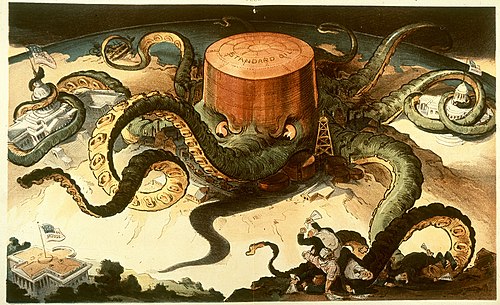
Octopus representing Standard Oil with arms wrapped around U.S. Congress and steel, copper, and shipping industries, and reaching for the White House
Trust (law)
Videos
A trust is a legal relationship in which the owner of property, or any transferable right, gives it to another to manage and use solely for the benefit of a designated person. In the English common la
Trust (business)
…The use of corporate trusts during this period is the historical reason for the name "antitrust law". In the broader sense of the term, relating to trust law, a trust is a legal arrangement based on principles developed and recognised over centuries in English law, specifically in equity, by which one party…

Microcosm of London Plate 022 Court of Chancery, Lincoln's Inn Hall edited