Tupinambá people
Videos
The Tupinambá are one of the various Tupi ethnic groups that inhabit present-day Brazil, and who had been living there long before the conquest of the region by Portuguese colonial settlers. The name
Babau Tupinambá [pt], a cacique of the Tupinambá
![Babau Tupinambá [pt], a cacique of the Tupinambá](https://upload.wikimedia.org/wikipedia/commons/thumb/3/3a/Cacique_Babau_Tupinamb%C3%A1_-_2014.jpg/500px-Cacique_Babau_Tupinamb%C3%A1_-_2014.jpg)

The France Antarctique (Brazilian ball) for Henry II of France in Rouen, 1 October 1550. Over 300 nude men were employed to illustrate life in Brazil, and a mock battle between the Tupinambá allies of the French and the Tabajara people.

Original 1557 Hans Staden woodcut of the Tupinambá portrayed in a cannibalistic feast.

Catarina Paraguaçu, wife of Portuguese sailor Diogo Álvares Correia, in an 1871 painting.
Tupi people
Videos
The Tupi people, a subdivision of the Tupi-Guarani linguistic families, were one of the largest groups of Indigenous peoples in Brazil before its colonization. Scholars believe that while they first s
Tupinambá people
…The Tupinambá (plural: Tupinambás) are one of the various Tupi ethnic groups that inhabit present-day Brazil, and who had been living there long before the conquest of the region by Portuguese colonial settlers…

Albert Eckhout's painting of the Tupi
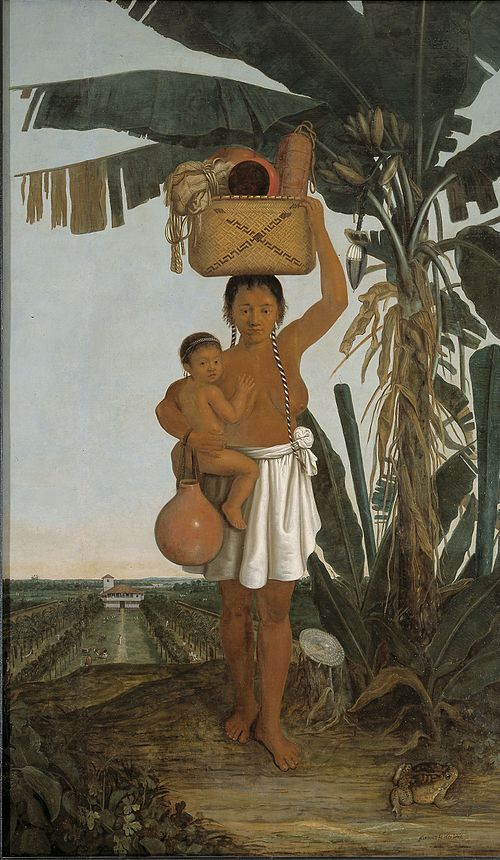
India tupi

Albert Eckhout: a mixed-race (Mameluco) woman (circa 1641–1644)

A Tupiniquim chief (Cacique) in Brasília, 2007