Turbidity current
Videos
A turbidity current is most typically an underwater current of usually rapidly moving, sediment-laden water moving down a slope; although current research indicates that water-saturated sediment may b

Turbidites are deposited in the deep ocean troughs below the continental shelf, or similar structures in deep lakes, by turbidity currents which slide down the slopes.

Longitudinal section through an underwater turbidity current
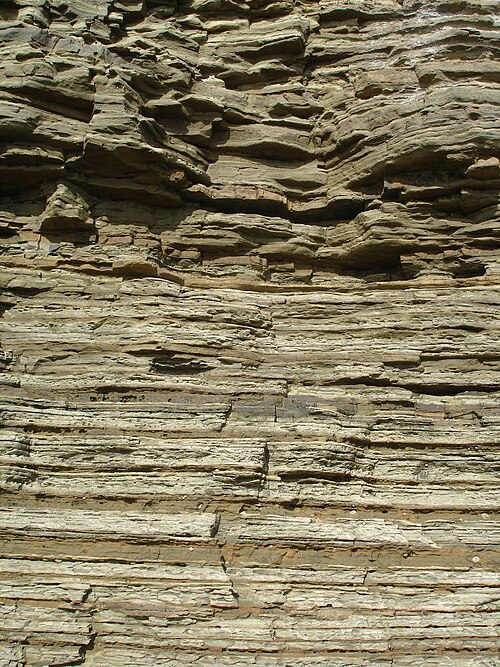
Turbidite interbedded with finegrained dusky-yellow sandstone and gray clay shale that occur in graded beds, Point Loma Formation, California.
Turbidite
Videos
A turbidite is the geologic deposit of a turbidity current, which is a type of amalgamation of fluidal and sediment gravity flow responsible for distributing vast amounts of clastic sediment into the
Turbidity current
…main oceanic floor), the particles borne by the current settle out of the water column. The sedimentary deposit of a turbidity current is called a turbidite. Seafloor turbidity currents are often the result of sediment-laden river outflows, and can sometimes be initiated by earthquakes, slumping and other…

Complete Bouma sequence in Devonian Sandstone (Becke-Oese Quarry, Germany)

Gorgoglione Flysch, of Miocene age, South Italy