Typewriter
Videos
A typewriter is a mechanical or electromechanical machine for typing characters. Typically, a typewriter has an array of keys, and each one causes a different single character to be produced on paper
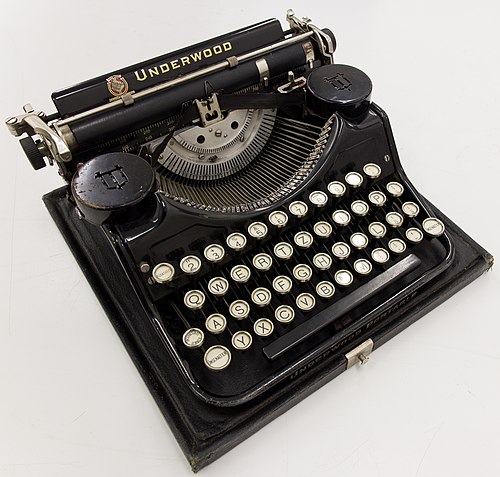
Mechanical typewriters, such as this 1930s Underwood, were long-time standards in government agencies, newsrooms, and offices.

Peter Mitterhofer's typewriter prototype (1864)

Hansen Writing Ball was the first typewriter manufactured commercially (1870).

Prototype of the first commercially successful typewriter, the Sholes and Glidden (1873) – with the first QWERTY keyboard
Manuscript
Videos
A manuscript was, traditionally, any document written by hand or typewritten, as opposed to mechanically printed or reproduced in an indirect or automated way. More recently, the term has come to be u
Typewriter
…his use of the product in its first product catalog. Twain claimed that he was the first important writer to present a publisher with a typewritten manuscript, for The Adventures of Tom Sawyer (1876). Research showed that Twain's memory was incorrect and that the first book submitted in typed form was Life…

Christ Pantocrator seated in a capital "U" in an illuminated manuscript from the Badische Landesbibliothek, Germany (from c. 1220)

Image of two facing pages of the illuminated manuscript of "Isagoge", fols. 42b and 43a. On the top of the left hand page is an illuminated letter "D" – initial of "De urinarum differencia negocium" (The matter of the differences of urines). Inside the letter is a picture of a master on bench pointing at a raised flask while lecturing on the "Book on urines" of Theophilus. The right hand page is only shown in part. On its very bottom is an illuminated letter "U" – initial of "Urina ergo est colamentum sanguinis" (Urine is thus the filtrate of the blood). Inside the letter is a picture of a master holding up a flask while explaining the diagnostic significance of urine to a student or a patient. HMD Collection, MS E 78.

Inside the letter is a picture of a master in cathedra expounding on the Aphorisms of Hippocrates. Initial "V" rendered as "U" of "Vita brevis, ars vero longa", or "Life is short, but the art is long". "Isagoge", fol. 15b. HMD Collection, MS E 78.

Manuscript, Codex Manesse. Most manuscripts were ruled with horizontal lines that served as the baselines on which the text was entered.