The UN offensive into North Korea was a large-scale offensive in late 1950 by United Nations forces against North Korean forces during the Korean War.

3rd Division Republic of Korea Army troops with sign at the 38th Parallel

ROK 23rd Regiment, 3rd Division troops advance through Kosong

The Kumch'on Pocket, 9–14 October 1950

3RAR prepare to move across the 38th Parallel
Second Phase Offensive
Videos
The Second Phase Offensive or Second Phase Campaign of the Korean War was an offensive by the Chinese People's Volunteer Army against United Nations Command forces, most of which were soldiers of Sout
UN offensive into North Korea
…in late October – early November, the UN renewed their offensive on 24 November before it was abruptly halted by massive Chinese intervention in their Second Phase Offensive starting on 25 November. North Korea invaded South Korea at the end of June 1950 in Operation Pokpung. By late-July, South Korea was reduced to the…

Chinese soldiers setting up an ambush, late 1950.
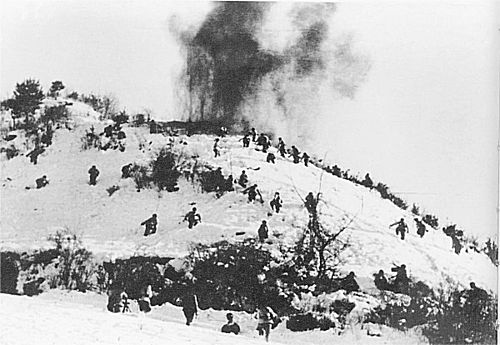
Chinese advance on a U.S./UN position. "Contrary to popular belief the Chinese did not attack in 'human waves', but in compact combat groups of 50 to 100 men".