Ukiyo-e
Videos
Ukiyo-e is a genre of Japanese art that flourished from the 17th through 19th centuries. Its artists produced woodblock prints and paintings of such subjects as female beauties; kabuki actors and sumo
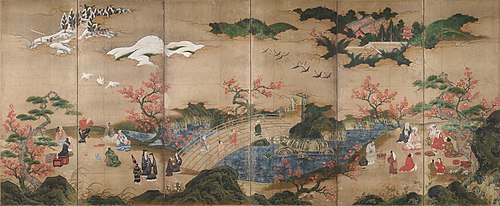
Maple Viewing at Takao (mid-16th century) by Kanō Hideyori is one of the earliest Japanese paintings to feature the lives of the common people.

Tokugawa Ieyasu established his government in the early 17th century in Edo (modern Tokyo).Portrait of Tokugawa Ieyasu, Kanō school painting, Kanō Tan'yū, 17th century
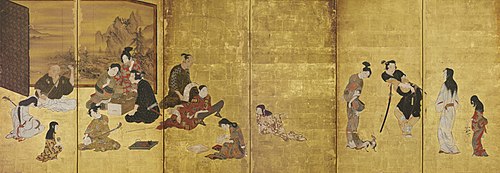
The Hikone screen may be the oldest surviving ukiyo-e work, dating to c. 1624–1644.

Early woodblock print, Hishikawa Moronobu, late 1670s or early 1680s
Takiyasha the Witch and the Skeleton Spectre or Mitsukuni Defying the Skeleton Spectre Invoked by Princess Takiyasha is an ukiyo-e woodblock triptych by Japanese artist Utagawa Kuniyoshi. Kuniyoshi wa
Ukiyo-e
…Cuckoo and Azaleas, Hokusai, 1828 Takiyasha the Witch and the Skeleton Spectre, Kuniyoshi, c. 1844 Ukiyo-e (Japanese: 浮世絵) is a genre of Japanese art that flourished from the 17th through 19th centuries. Its artists produced…

Triptych of Takiyasha the Witch and the Skeleton Spectre, c. 1844, Utagawa Kuniyoshi (1797–1861), British Museum no. 1915,0823,0.915-916