Ukrainian underground was a movement in Ukraine's Soviet period within Soviet nonconformist art from the late 1950s through the early 1990s. This art form was banned by several totalitarian countries of Eastern Europe and the USSR. It was also known under other names, such as unofficial art, nonconformist, and dissident art.
It ended due to the Perestroika reform movement, which led to Ukrainian independence in 1991. After the Soviet Union collapsed, similar counter-cultural processes developed under the names of "alternative" or "marginal" art. The avant-garde ideas of underground art were picked up and developed by the next generation of the Ukrainian New Wave.
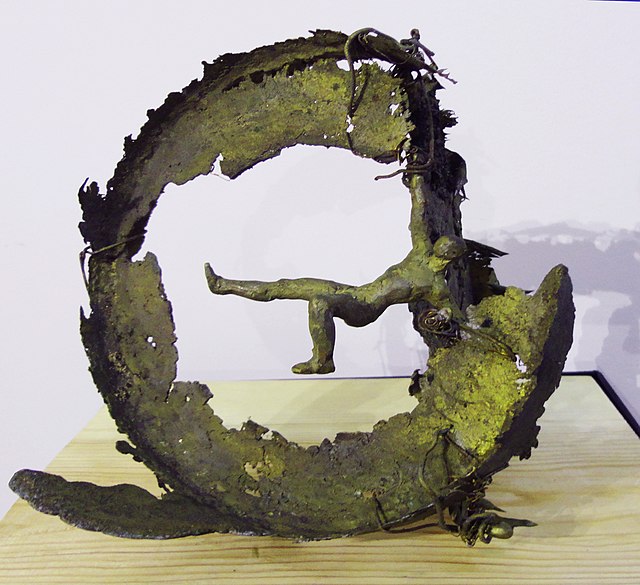
"Man and infinity", object by Ukrainian artist F.Tetianych,1980
Irina Vysheslavska. Self-portrait with Viktor Pivovarov and Eduard Gorokhovsky. 1975
Balcony painting by Anatoly Sumar 1958
Artist Florian Yuriev at his exhibition Painting 1960–70 in the National Art Museum of Ukraine, 2016
Soviet nonconformist art was Soviet art produced in the former Soviet Union outside the control of the Soviet state started in the Stalinist era, in particular, outside of the rubric of Socialist Realism. Other terms used to refer to this phenomenon are Soviet counterculture, "underground art" or "unofficial art".
USSR stamp by Aleksandr Gerasimov
Ernst Neizvestny. The Prophet. Sculpture Park, Uttersberg, Sweden
Timur Novikov
Oleg Vasiliev, Before the Sunrise, 1964