Unionism in Ireland
Videos
Unionism in Ireland is a political tradition that professes loyalty to the crown of the United Kingdom and to the union it represents with England, Scotland and Wales. The overwhelming sentiment of Ir

Hazards of separation from Great Britain. Unionist postcard opposing Irish home rule, 1912.

Detail of the Battle of Ballynahinch 1798 by Thomas Robinson. Government Yeomanry prepare to hang United Irish insurgent.

1899 penny print of Henry Cooke's 1841 speech in "reply to Daniel O'Connell"

God Save the Queen, Erin Go Bragh, Ulster Unionist Convention, Belfast, 1892
Ulster loyalism
Videos
Ulster loyalism is a strand of Ulster unionism associated with working class Ulster Protestants in Northern Ireland. Like other unionists, loyalists support the continued existence of Northern Ireland
Unionism in Ireland
…Liberals coalesced with traditionally Anglican, Orange Order allied, Conservatives against the Irish Home Rule Bills of 1886 and 1893. Joined by loyalist labour, on the eve of World War I this broad opposition to Irish self-government concentrated in Belfast and its hinterlands as Ulster unionism and…

The Union Flag, Ulster Banner and Orange Order flags are often flown by loyalists in Northern Ireland.

Ulster Volunteers in Belfast c. 1914
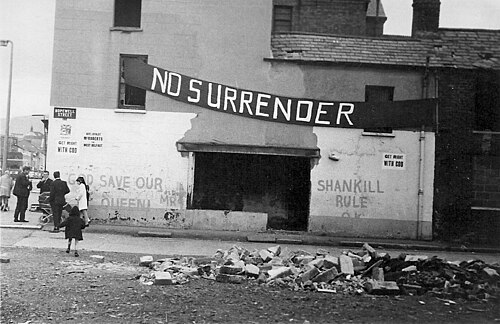
Loyalist graffiti and banner on a building in a side street off the Shankill Road, Belfast (1970)

A loyalist marching band on The Twelfth, 2011