In the United States, the Electoral College is the group of presidential electors that is formed every four years for the sole purpose of voting for the president and vice president in the presidentia

The New York electoral college delegation voting for Benjamin Harrison for president. In the 1888 election, Harrison became one of the five presidents elected without winning the popular vote.

Cases of certificates of the electoral college votes confirming the results of the 2020 US election, after they had been removed from the House Chambers by congressional staff during the January 6 United States Capitol attack

When a state's electors meet in December, they cast their ballots and record their vote on a Certificate of Vote, which is then sent to the U.S. Congress. The certificate shown is from the 1876 election.
The election of the president and vice president of the United States is an indirect election in which citizens of the United States who are registered to vote in one of the fifty U.S. states or in Wa
United States Electoral College
…College is the group of presidential electors that is formed every four years for the sole purpose of voting for the president and vice president in the presidential election. This process is described in Article Two of the Constitution. The number of electors from each state is equal to that state's congressional delegation…
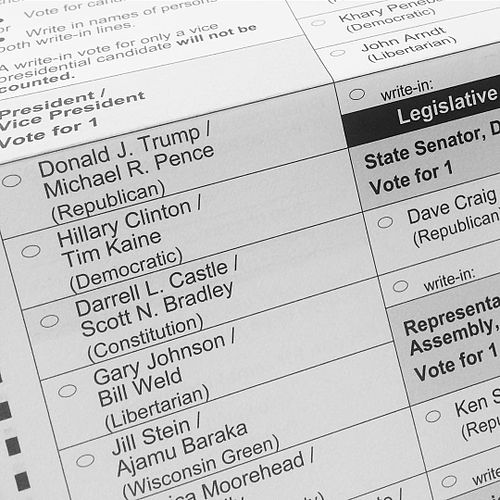
A ballot for the 2016 presidential election and for other elections that year, listing the presidential and vice presidential candidates

A 2008 Democratic caucus meeting in Iowa City, Iowa. The Iowa caucuses are traditionally the first major electoral event of presidential primaries and caucuses.

Madison Square Garden in New York City, the site of the 1976, 1980, and 1992 Democratic National Conventions; and the 2004 Republican National Convention

The floor of the 2008 Republican National Convention at the Xcel Energy Center in Saint Paul, Minnesota