Ushitora Gongyo
Videos
Ushitora Gongyo is a Buddhist liturgy service conducted in Nichiren Shōshū Buddhism. The service is traditionally held at 2:30 AM at the Kyakuden building of Taisekiji Head Temple, located within the

The Gohonzon of Nikko Shonin inside the Dai-Kyakuden (大客殿, Grand Reception Hall) (transcribed into wood on 15 June 1706) where the ceremony is held exclusively for its Hokkeko believers from various countries participating in the 2:30AM Buddhist service. The High Priest sits opposite in the left side seat. Taisekiji Head Temple, Japan.

The rotation of the Chinese Zodiac per animal sign which indicates the Buddhist time assigned to the Ushitora service. A woodcarving at the Kushida Shinto Shrine, Fukuoka, Japan.

An image of a Buddhist goddess, Tennin riding a cloud, a form of Shoten Zenjin protector deity invoked by believers during the Ushitora service.
Dai Gohonzon
Videos
The Dai Gohonzon of the High Sanctuary of the Essential Teachings, commonly known as the Dai Gohonzon is a venerated mandala image inscribed with both Sanskrit and Chinese logographs on a median log t
Ushitora Gongyo
…of Taisekiji Head Temple, located within the lower slopes of Mount Fuji, Japan. It is the morning prayer service which is indirectly offered to the Dai Gohonzon image, approximately one mile away from a distance area in accordance to the sect and beliefs of wide propagation. The Buddhist sect claims that the…

Honmon Kaidan Fr
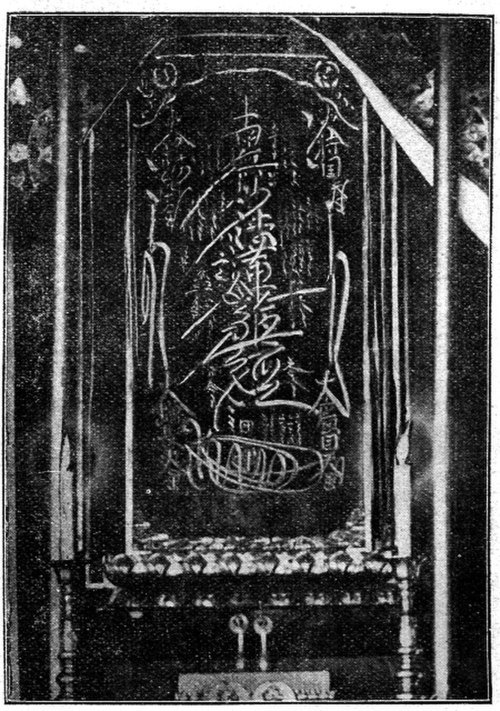
Photograph of the Dai Gohonzon at Taisekiji, printed in Kumada Ijō's (熊田葦城) book Nichiren Shōnin (日蓮上人), 8th edition, page 375, originally published in 1911.

A camphorwood statue of Shichimen Tennyo enshrined at Honkoji Temple in Ichikawa city in Chiba prefecture, with a Shinto mirror as part of her legend and mixed religious practice by the Nichiren Shu sect.

The Hoando storagehouse building in Taisekiji, where the Dai Gohonzon is currently enshrined.