Uvs Lake Basin
Videos
Photos
Uvs Lake Basin is an endorheic basin located on the territorial border of Mongolia and Tuva, a republic of the Russian Federation. The basin is part of the Central Asian Internal Drainage Basin and is named after Uvs Lake, a large saline lake situated in the western part of its drainage basin, and is one of the last remnants of the mammoth steppes. Uvs Lake is a shallow lake with an area of 3,350 km2 (1,290 sq mi). Its entire basin, which includes several smaller lakes, is 70,000 km2 (27,000 sq mi).

Uvs Lake Basin

Ubsunur Hollow covers the western part of the Uvs Nuur drainage basin

Great Lakes Depression (satellite, with names of lakes)

Por-Bazhyn, shortly before the 2007–2008 excavations
Endorheic basin
Videos
Photos
An endorheic basin is a drainage basin that normally retains water and allows no outflow to other, external bodies of water ; instead, the water drainage flows into permanent and seasonal lakes and swamps that equilibrate through evaporation. Endorheic basins are also called closed basins, terminal basins, and internal drainage systems.
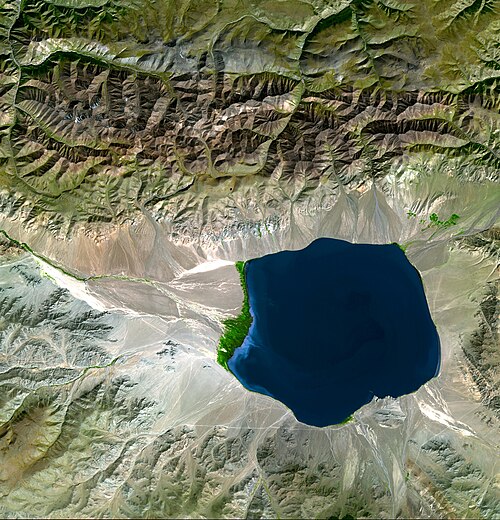
The endorheic basin that feeds water into Üüreg Lake, Mongolia

NASA photo of the endorheic Tarim Basin, China

The Okavango Delta (centre) of southern Africa, where the Okavango River spills out into the empty trough of the Kalahari Desert. The area was a lake fed by the river during the Ice Ages (national borders are superimposed)

The Caspian Sea, a large inland basin