Vanadis expedition
Videos
The Vanadis expedition was a sailing expedition around the world with the frigate Vanadis visiting South America, Oceania, Asia, and Europe. It took place between 1883 and 1885 and was commissioned by the United Kingdoms of Sweden and Norway. The expedition was of a military, economic, diplomatic, and scientific nature. It was partly a training mission and partly to promote Swedish maritime and trade. Captain of the ship was Otto Lagerberg. Other participants were Crown Prince Oscar, meteorologist Gottfrid Fineman and physician and marine biologist Dr. Karl Rudberg along with more than 300 officers and sailors. On board was also the Swedish archaeologist and ethnographer Hjalmar Stolpe who during land excursions collected 7,500 cultural specimens for an intended ethnographical museum in Sweden. The objects were acquired/purchased from indigenous and Western residents in all places Vanadis stopped. Stolpe was accompanied by photographer Oscar Ekholm which resulted in about 700 pictures.

Hjalmar Stolpe during the excavations in Ancon, Peru.

Vanadis approaching Jaluit in 1884. Painting by Jacob Hägg.
Oscar Bernadotte
Videos
Prince Oscar Carl August Bernadotte, Count of Wisborg was a Swedish religious activist, the second son of King Oscar II of Sweden and his consort, Sofia of Nassau. Born as a Prince of Sweden and Norway, he was known as Prince Oscar, Duke of Gotland. However, by marrying contrary to Swedish constitutional requirements, he lost those titles, becoming instead Luxembourgish nobility as Prince Bernadotte and Count of Wisborg.
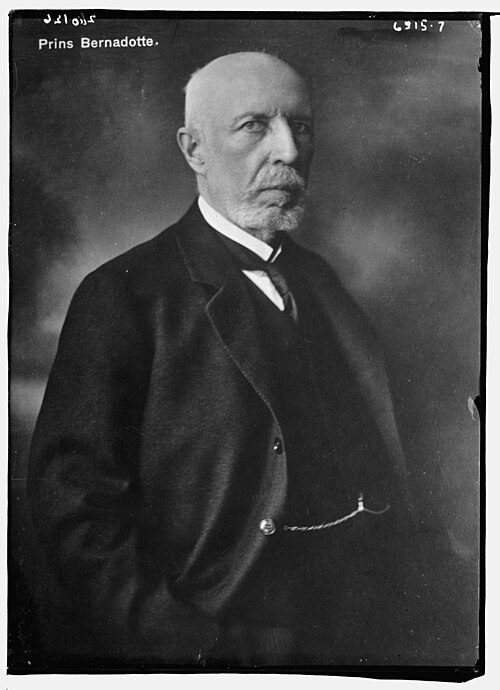
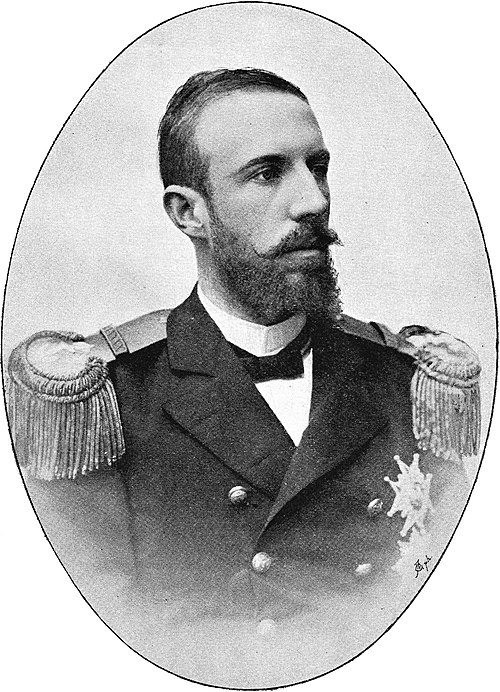
Photograph of Prince Oscar

Bernadotte's family grave north of Stockholm, where the remains of his assassinated son Folke Bernadotte also are interred