Vernacular
Videos
Vernacular is the ordinary, informal, spoken form of a language or dialect, particularly when perceived as having lower social status or less prestige than standard language, which is more codified, i

The oldest known vernacular manuscript in Scanian (Danish, c. 1250). It deals with Scanian and Scanian Ecclesiastical Law.

An allegory of rhetoric and arithmetic, Trinci Palace, Foligno, Italy, by Gentile da Fabriano, who lived in the era of Italian language standardization

Allegory of Dante Alighieri, champion of the use of vernacular Italian for literature rather than the lingua franca, Latin. Fresco by Luca Signorelli in the cappella di San Brizio dome, Orvieto
Latin
Videos
Latin is a classical language belonging to the Italic branch of the Indo-European languages. Latin was originally spoken by the Latins in Latium, the lower Tiber area around Rome, Italy. Through the e
Latin inscription on a stone inside the Colosseum in Rome, Italy


The Lapis Niger, probably the oldest extant Latin inscription, from Rome, c. 600 BC during the semi-legendary Roman Kingdom

A 9th century Byzantine coin showing emperor Michael III and his then-junior colleague Basil I with the Latin titles "imperator" and "rex", respectively. Although spoken Latin had largely disappeared in the Eastern Roman Empire by that time, it was occasionally still used on coinage and in ceremonies until at least the 11th century.
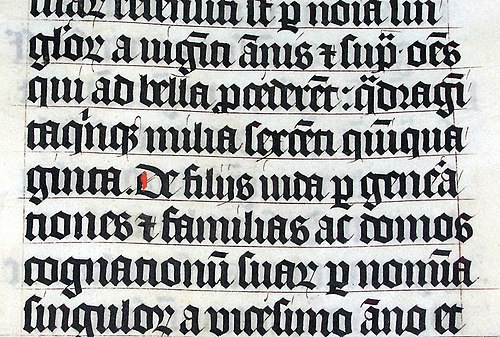
The Latin Malmesbury Bible, from 1407