Verse of walaya
Videos
The verse of walaya is verse 5:55 of the Quran, the central religious text of Islam. This verse specifies three authorities as the only sources of walaya for Muslims. In Sunni Islam, walaya in this co
Memorial stone of the Shia imam Ali al-Rida, on display in the Razavi museum, Mashhad, Iran. The stone was carved by Abd-Allah ibn Ahmad in the Seljuk era. The verse of walaya is engraved on its margins.

Ali
Videos
Ali ibn Abi Talib was the fourth Rashidun caliph who ruled from 656 CE until his assassination in 661, as well as the first Shia Imam. He was the cousin and son-in-law of the Islamic prophet Muhammad.
Gouache illustration of Ali (centre) and his sons, Hasan and Husayn, 1838, by an unknown painter

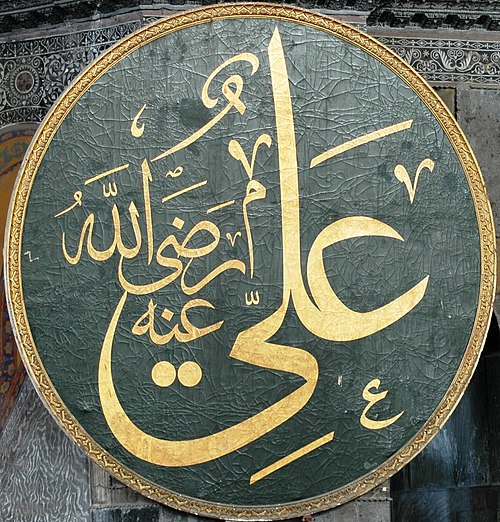
Istanbul Santa Sofia Medalló

Fonds Christian Bromberger Affiches de la période de la Révolution islamique Au premier plan Ali ibn Abi Talib, premier imam chiite, se tient derrière un lion, un sabre à la main et un paysa

Sasanid style coins during the Rashidun period, featuring a crescent-star, fire altar, depictions of Khosrow II, and an Arabic bismillāh in the margin). Unlike known historical figures such as Ibn Zubayr and Mu'awiya I, there are no coins minted in the name of these caliphs that could be evidence of political sovereignty.