Very high frequency
Videos
Very high frequency is the ITU designation for the range of radio frequency electromagnetic waves from 30 to 300 megahertz, with corresponding wavelengths of ten meters to one meter. Frequencies immed
VHF television antennas used for broadcast television reception. These six antennas are a type known as a Yagi antenna, which is widely used on VHF.

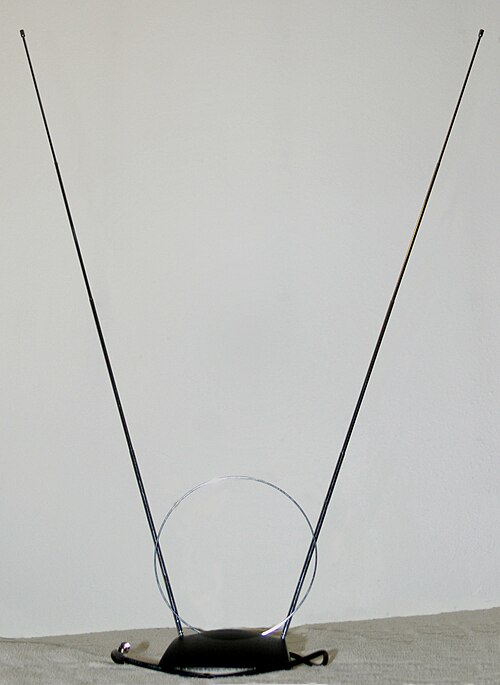
"Rabbit-ears" VHF television antenna (the small loop is a separate UHF antenna)

A VHF television broadcasting antenna. This is a common type called a super turnstile or batwing antenna.
FM broadcasting
Videos
FM broadcasting is a radio broadcasting method that uses frequency modulation transmissions. In November 1919, Hans Idzerda began broadcasts, using narrow-band FM, over station PCGG, located at The Ha
Very high frequency
…somewhat beyond the visual horizon out to about 160 km (100 miles). Common uses for radio waves in the VHF band are Digital Audio Broadcasting (DAB) and FM radio broadcasting, television broadcasting, two-way land mobile radio systems (emergency, business, private use and military), long range data communication…

A commercial 35 kW FM radio transmitter built in the late 1980s. It belongs to FM radio station KWNR, in Henderson, Nevada, and broadcasts on 95.5 MHz.
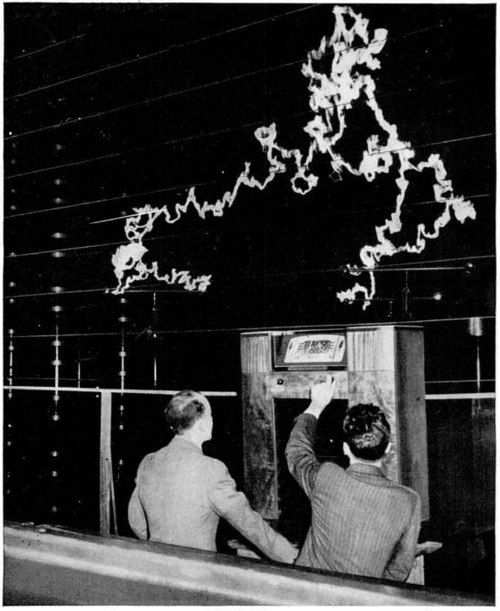
FM has better rejection of static (RFI) than AM. This was shown in a dramatic demonstration by General Electric at its New York lab in 1940. The radio had both AM and FM receivers. With a million-volt arc as a source of interference, the AM receiver produced a roar of static, while the FM receiver clearly reproduced a music program from Armstrong's experimental FM transmitter in New Jersey.

Crossed-dipole antenna array of station KENZ's 94.9 MHz, 48 kW transmitter on Lake Mountain, Utah. It radiates circularly polarized radio waves.

Armstrong's first prototype FM broadcast transmitter, located in the Empire State Building, New York City, which he used for secret tests of his system between 1934 and 1935. Licensed as experimental station W2XDG, it transmitted on 41 MHz at a power of 2 kW.