Vietnamese language
Videos
Vietnamese is an Austroasiatic language primarily spoken throughout Vietnam where it is the official language. It belongs to the Vietic subgroup of the Austroasiatic language family. Vietnamese is spo
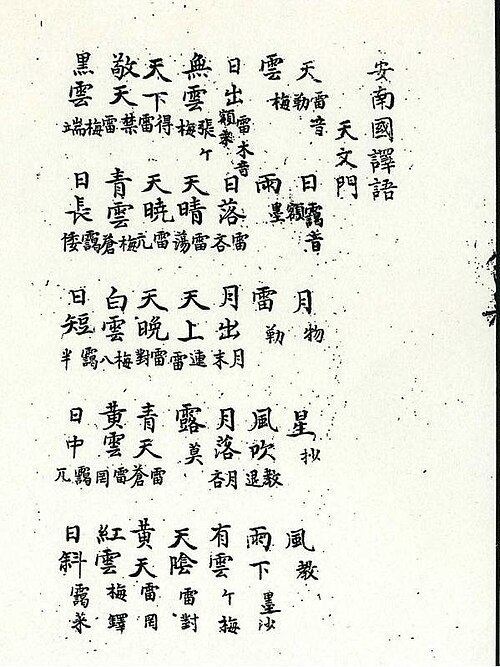
An Nam quốc dịch ngữ 安南國譯語 records the pronunciations of 15th-century Vietnamese, such as for 天 (sky) – 雷 /luei/ representing blời (Modern Vietnamese: trời).

Four tones diagram shown in the book Thiền lâm bảo huấn hợp chú 禪林寶訓合註 (1858; Tự Đức thập nhất niên 嗣德十一年).

In the bilingual dictionary Nhật dụng thường đàm (1851), Chinese characters (chữ Nho) are explained in chữ Nôm.

Jean-Louis Taberd's dictionary Dictionarium anamitico-latinum (1838) represents Vietnamese (then Annamese) words in the Latin alphabet and chữ Nôm.
Vietnam
Videos
Vietnam, officially the Socialist Republic of Viet Nam, is a country at the eastern edge of Mainland Southeast Asia. With an area of about 331,000 square kilometres and a population of over 102 millio
Vietnamese language
…Vietnamese (tiếng Việt) is an Austroasiatic language primarily spoken throughout Vietnam where it is the official language. It belongs to the Vietic subgroup of the Austroasiatic language family. Vietnamese is spoken natively by around 86…

Capture of Saigon by Charles Rigault de Genouilly on 18 February 1859

The Grand Palais built for the 1902–1903 world's fair, when Hanoi became French Indochina's capital

First Nationwide Congress of Emulation Fighters, Democratic Republic of Vietnam, 1952

Three US Fairchild UC-123B aircraft spraying Agent Orange during the Operation Ranch Hand as part of a herbicidal warfare operation depriving the food and vegetation cover of the Việt Cộng, c. 1962–1971