WE.177
Videos
The WE.177, originally styled as WE 177, and sometimes simply as WE177, was a series of tactical and strategic nuclear weapons with which the Royal Navy and the Royal Air Force were equipped. It was t

WE.177 nuclear bomb (training example) at Explosion Museum of Naval Firepower

Rare WE.177A sectioned instructional example of an operational round, one of only two in existence, seen here at Boscombe Down Aviation Collection.
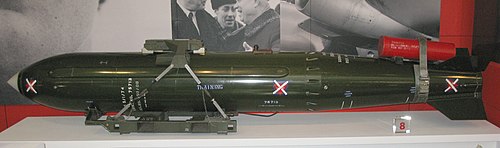
A WE.177B or C training round for ground instructional purposes. Externally identical to operational rounds, but manufactured in steel rather than aluminium alloy, and inert; i.e., does not contain any fissile materials, explosives, or other hazardous components. The red canister contains the cable required to connect the weapon to the aircraft systems. The white 'X's cover cartridge-operated ejection ports, and signify that as an inert round, explosive charges are not installed. 'Live' WE.177 bombs had a two inch wide orange band around the circumference of the nose.

WE.177 safety and arming keys. The large white plastic part is the tool used to remove the protective cover from the lock.
Red Beard (nuclear weapon)
Videos
Red Beard was the first British tactical nuclear weapon. It was carried by Royal Air Force English Electric Canberra medium bombers and the V bomber force and by Supermarine Scimitars, de Havilland Se
WE.177
…cancelled, the UK gained access to the UGM-27 Polaris missile and its W58 warhead, but they continued development of Cleo as a tactical weapon to replace Red Beard. A later requirement for a much smaller tactical and anti-submarine weapon for Navy use was filled by using the new primary as a boosted fission weapon…

A Red Beard weapon on its bomb trolley, fitted with a bomb carrier prior to loading into an English Electric Canberra bomber. The two fore and aft vertical plates shown with holes in them were baffles unique to the Canberra installation, designed to reduce airstream buffeting that could tear off the bomb doors. The baffles were made from 1 in (25 mm) thick marine plywood, drilled with numerous 1 in (25 mm) diameter holes. The tail fins of the bomb are retracted.

Explosion of a Red Beard warhead (codenamed Buffalo R1/One Tree, fired on 27 September 1956) during the British nuclear tests at Maralinga

A Red Beard training variant on display at Explosion Museum of Naval Firepower

A Red Beard casing at RAF Cosford museum in 2007, shown without the 'drop' harness, and on the regular dolly